A child who hands over the card, not the cup
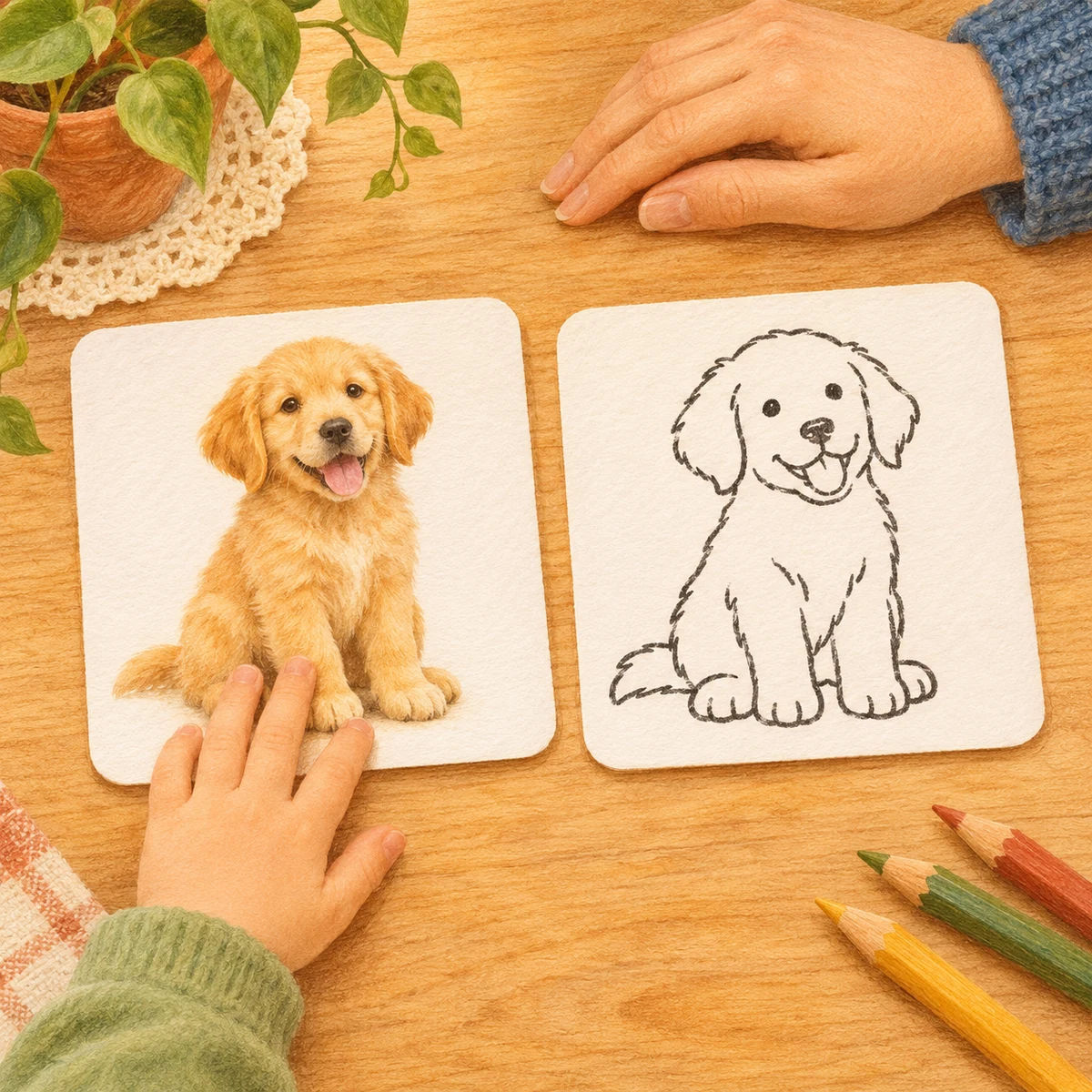
Leo is four years old. He is an invented example. He has learned the word “cup” from a black line drawing. His Instructor puts that drawing and a real cup on the table and says, “Give me the cup.” Leo hands over the card.
Preissler (2008) taught a new word to children with autism and limited language, using a black-and-white line drawing. Then she put that drawing next to the real object, which the children had not seen before, and asked them to point it out. The children with autism tied the word to the drawing and not to the object. Typically developing children with similar language comprehension did not respond that way.
Hartley and Allen (2015b) repeated the test with four types of image. The children with autism still tied the word to the image more than to the object. But they carried it over to the object more often when the image was in color.
Understanding that an image stands for something else is called symbolic understanding. What makes it symbolic is that the child takes the word to the object, not only to the card. DeLoache (2000), who studied this with scale models and two- and three-year-olds, called it “dual representation”: thinking about the symbol as a thing and, at the same time, about what it stands for.
What the studies in favor of the photo find
A child sees three images and hears a new word. Five minutes later, the child is asked for it again. Carter and Hartley (2021) ran this test with 20 children with autism, with a mean age of 6 years 8 months, and 20 typically developing children, with a mean age of 3 and a half. The children with autism remembered more words when they had learned them from color photos than from black-and-white drawings.
In a task that involved finding a hidden toy, children with autism and typically developing children found it without errors more often when the clue was a color photo than when it was a line drawing (Hartley & Allen, 2015a).
For typically developing 15-month-olds, a name learned from a book reached the real object when the book had photos or realistic drawings. It did not when the book had cartoon-like drawings. At 18 months it reached the object with all three types of image (Ganea et al., 2008).
Among 40 nonspeaking people with intellectual disabilities, some with autism, real objects were the easiest to recognize (Mirenda & Locke, 1989).
A color photo keeps the object’s shape, color, and texture. That degree of resemblance between an image and what it represents is called iconicity.
What the evidence does not show
Four children with autism, aged 6 to 9, learned to ask for things by handing over a symbol. Some symbols looked like the object and others hardly at all. All four learned with both types, with little difference (Angermeier et al., 2008).
A doctoral dissertation compared digital photographs with drawn symbols in four children aged 22 to 36 months, with autism or a developmental delay. According to its abstract, the difference between the two types in learning to tell the images apart was minimal (Jonaitis, 2011). It is the only work we found with children that young.
Among the typically developing children in Carter and Hartley (2021), no statistically significant difference was detected between photos and drawings. One review concludes that resemblance may matter somewhat, but that other variables probably matter more (Stephenson, 2009).
The favorable studies also have limits. They have few participants. Almost all are school-age children, not two- or three-year-olds. They assess specific tasks, such as learning a word or finding a toy with the help of a picture, in one or a few sessions. They do not compare two ways of teaching kept up for weeks. They used photographs taken with a camera, and the realistic images in the Interlaza library were created with AI tools: no study we know of compares the two. And we found none that compares starting with photos and starting with drawings in match-to-sample exercises, where the child picks the image that goes with a model.
Why we still start with the photo
When a new exercise is created in Interlaza, the realistic images appear by default; this article calls them photos for short. This is our decision, with three reasons.
First: in children with autism and limited language, the studies we located that find a difference between photo and drawing find it in favor of the color photo. There are three of them, and all three come from the same research group.
Second: if the image looks more like the real thing, we expect the child to find it easier to recognize that thing away from the tablet. That is an expectation, not a result we have measured.
Third: the risks of the photo can be watched, and the sections below say how.
That is why we say Interlaza “starts with” the photo, and not that the photo is better.
When to consider the drawing
Four preschool children with autism learned symbols on a computer, some in color and some in gray scale. There were no apparent differences in learning them. But two of them did better with the other version when they had started with the gray one (Hetzroni & Ne’eman, 2013).
The detail in a photo can become the thing the child follows. In one study with color photos, children with autism and limited language extended a new word to things that shared only the color, or only the shape, with the photo. The comparison children extended it only to things with the same shape (Hartley & Allen, 2014).
This is our reading. These results are a reason to watch which detail each child follows, and to try the drawing if the child fixes on an incidental detail in photos. They do not show that starting with drawings is better. With more language, the drawing stops being an obstacle: 20 children with autism, with a mean age of 11, who understood language like a child of about four and a half, matched line drawings to real objects with no detectable difference from typically developing children (Hartley et al., 2019). That study did not compare starting with drawings against starting with photos.
What Interlaza does so the child does not get stuck on one photo
In Interlaza, “dog” is not one photo repeated. Many concepts have several different photos: three different dogs, not the same dog three times.
The idea of using several photos rests on a study of 16 children with autism and limited language, aged 4 to 16 (Allen et al., 2015). They learned a new word from a single repeated photo or from several photos of the object in different colors. With several photos, more children took the word to the real object, but the direct comparison did not give enough evidence to conclude that several photos were better than one. It is a single study and it changed only the color of the same object. That it holds equally for three different dogs is our assumption.
The white background is there so that the background is not a cue. The support is old and indirect: for five adolescents with severe intellectual disabilities, matching photos to objects seemed easier when the figure was cut out, with no background or frame (Dixon, 1981).
Going from the photo to the drawing is a separate exercise in Interlaza, with its own record. We do not assume the child will do it unaided. In the study of color and gray symbols, moving from one version to the other did not go the same way for every child.
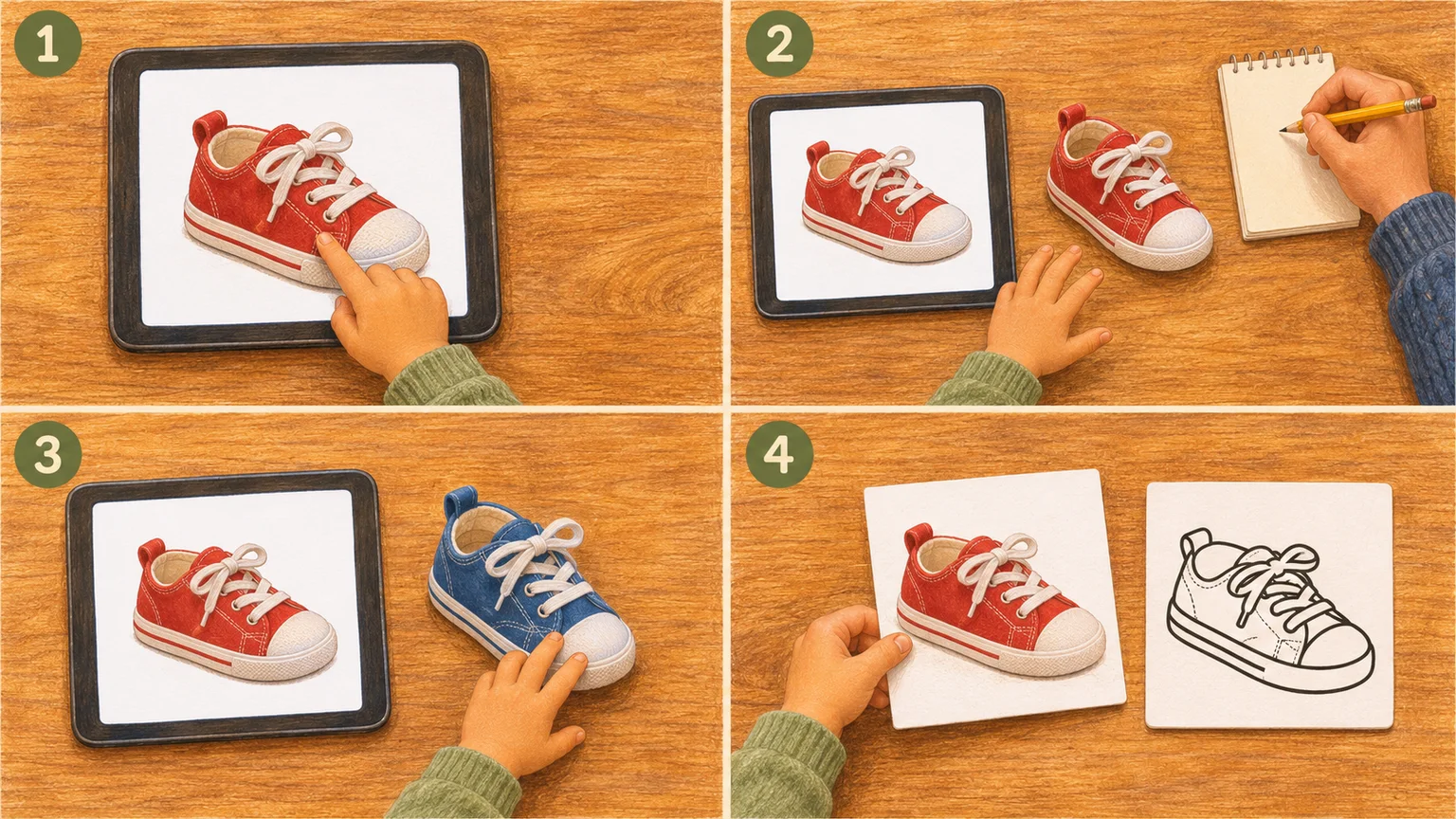
To try: has the word left the photo?
This is our suggestion for observing, not a treatment recommendation. The four panels are the first four steps.
References
- Allen, M. L., Hartley, C., & Cain, K. (2015). Do iPads promote symbolic understanding and word learning in children with autism? Frontiers in Psychology, 6, 138. https://doi.org/10.3389/fpsyg.2015.00138
- Angermeier, K., Schlosser, R. W., Luiselli, J. K., Harrington, C., & Carter, B. (2008). Effects of iconicity on requesting with the Picture Exchange Communication System in children with autism spectrum disorder. Research in Autism Spectrum Disorders, 2(3), 430–446. https://doi.org/10.1016/j.rasd.2007.09.004
- Carter, C. K., & Hartley, C. (2021). Are children with autism more likely to retain object names when learning from colour photographs or black-and-white cartoons? Journal of Autism and Developmental Disorders, 51(9), 3050–3062. https://doi.org/10.1007/s10803-020-04771-2
- DeLoache, J. S. (2000). Dual representation and young children’s use of scale models. Child Development, 71(2), 329–338. https://doi.org/10.1111/1467-8624.00148
- Dixon, L. S. (1981). A functional analysis of photo-object matching skills of severely retarded adolescents. Journal of Applied Behavior Analysis, 14(4), 465–478. https://doi.org/10.1901/jaba.1981.14-465
- Ganea, P. A., Pickard, M. B., & DeLoache, J. S. (2008). Transfer between picture books and the real world by very young children. Journal of Cognition and Development, 9(1), 46–66. https://doi.org/10.1080/15248370701836592
- Hartley, C., & Allen, M. L. (2014). Brief report: Generalisation of word–picture relations in children with autism and typically developing children. Journal of Autism and Developmental Disorders, 44(8), 2064–2071. https://doi.org/10.1007/s10803-014-2074-1
- Hartley, C., & Allen, M. L. (2015a). Iconicity influences how effectively minimally verbal children with autism and ability-matched typically developing children use pictures as symbols in a search task. Autism, 19(5), 570–579. https://doi.org/10.1177/1362361314536634
- Hartley, C., & Allen, M. L. (2015b). Symbolic understanding of pictures in low-functioning children with autism: The effects of iconicity and naming. Journal of Autism and Developmental Disorders, 45(1), 15–30. https://doi.org/10.1007/s10803-013-2007-4
- Hartley, C., Trainer, A., & Allen, M. L. (2019). Investigating the relationship between language and picture understanding in children with autism spectrum disorder. Autism, 23(1), 187–198. https://doi.org/10.1177/1362361317729613
- Hetzroni, O. E., & Ne’eman, A. (2013). Influence of colour on acquisition and generalisation of graphic symbols. Journal of Intellectual Disability Research, 57(7), 669–680. https://doi.org/10.1111/j.1365-2788.2012.01584.x
- Jonaitis, C. (2011). The Picture Exchange Communication System: Digital photographs versus picture symbols [Doctoral dissertation]. ProQuest. https://eric.ed.gov/?id=ED529147
- Mirenda, P., & Locke, P. A. (1989). A comparison of symbol transparency in nonspeaking persons with intellectual disabilities. Journal of Speech and Hearing Disorders, 54(2), 131–140. https://doi.org/10.1044/jshd.5402.131
- Preissler, M. A. (2008). Associative learning of pictures and words by low-functioning children with autism. Autism, 12(3), 231–248. https://doi.org/10.1177/1362361307088753
- Stephenson, J. (2009). Iconicity in the development of picture skills: Typical development and implications for individuals with severe intellectual disabilities. Augmentative and Alternative Communication, 25(3), 187–201. https://doi.org/10.1080/07434610903031133