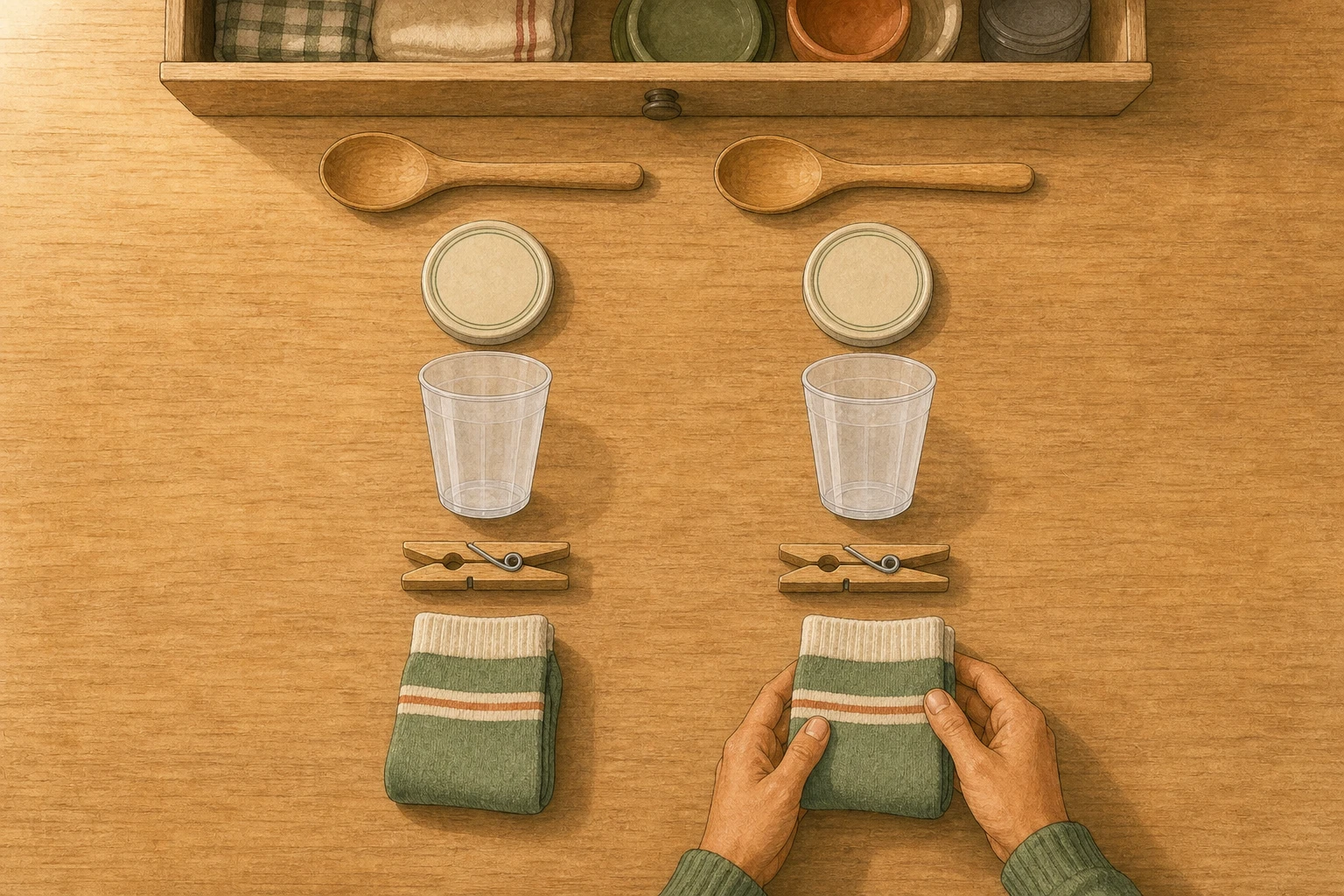
The search for teaching materials usually starts with a shopping list and ends with a full cupboard. It is worth starting from the other end: what does the material have to do, and then what needs buying, which is almost always less than it looked.
The four properties
Duplicate copies. Identity matching — the same image on both sides — needs two identical exemplars of the same thing; other kinds of matching, like a photo to a word, don’t. This is the number one reason an identity activity cannot be run: there is one apple and two are needed.
One relevant difference. If you are teaching color, the two cards should differ in color and not much else. A large red drawing against a small blue one can be answered on size, and nobody finds out — which is also why the two properties should never move together across an entire set (see below).
Several exemplars of the same thing. Three different dogs, not the same dog three times. That widens what the child practices with, and it costs nothing extra: three images instead of one. It does not by itself prove the child has learned “dog” rather than three particular photographs — checking that needs a novel exemplar and, ideally, a novel setting.
Durability. Thick card or laminated, because material that bends on the third use interrupts the session exactly when it was going well.
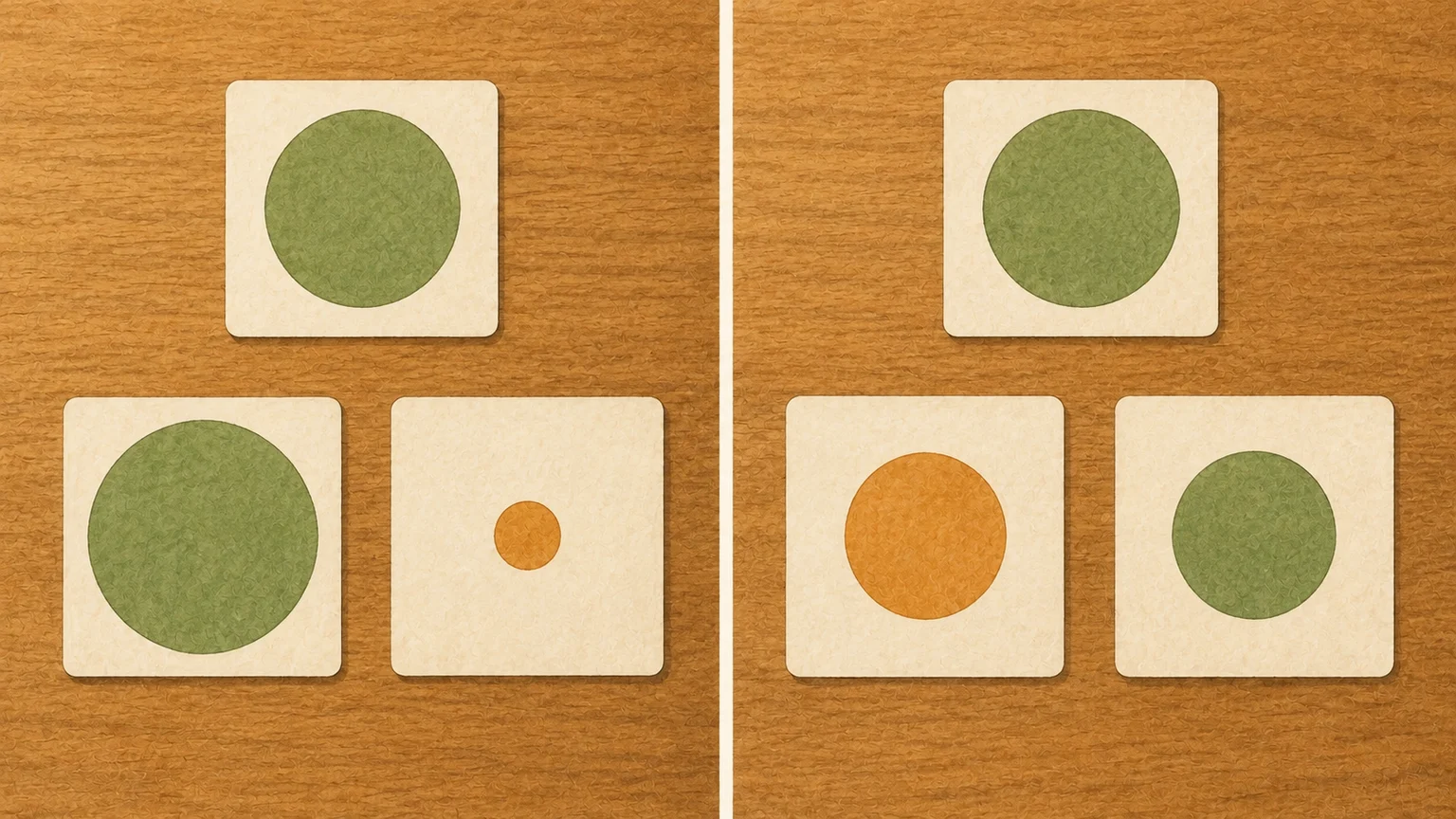
If “green” is also always “the biggest,” correct responding may depend on size. Matching option sizes removes that particular cue. Positions and exemplars still need to vary, with concepts interleaved, to check which property controls responding.
- Color and size change together
- Options have the same size
Start with real objects
Before any image there is the thing. For many children, matching two real spoons is more accessible than matching two photographs of spoons or matching a photograph to the spoon itself — though the exact order can vary by child.
That rough progression — object matching, then crossing between objects and photos, then photo to photo, then photo to drawing, then words — is also a map of what to buy: buy nothing until the child is past the step that can be run with what is in the kitchen, and adjust the order to the child in front of you rather than assuming it holds for every child.
Photos, drawings, and why you want both
A photograph shares a great many features with the real thing. A drawing shares few, deliberately: no background, no brand, no shadow. That helps a child distracted by the irrelevant and hinders a child who has not yet learned that an image stands for something — the same reason receptive-language teaching is usually built starting from the more concrete comparison (Grow & LeBlanc, 2013).
Having both of the same concept is what makes the crossing between them teachable, and that crossing is a skill in its own right that does not appear on its own. It is exactly what Interlaza’s library holds: each concept keeps its photograph and, where one exists, its drawing, and the exercise that goes from one to the other is a separate exercise with its own record.
What buying more does not fix
Materials matter less than most of what surrounds them. Ahead of them: how many opportunities there are, whether help is withdrawn on a plan, whether the consequence means anything, and whether anyone writes it down.
When something genuinely does need buying, prioritize by the goal it serves, how easy it is to get, and whether the child is actually interested in it — a set that sits unopened because nobody likes the pictures on it was money spent on nothing.
It is worth saying because buying is the pleasant part and it is the part that can be done on a Sunday. A tidy cupboard has never taught anything, and a shoebox with five pairs of objects, used well, teaches a great deal.
Further reading
- ABA therapy activities — how the session is arranged around the material.
- Generalization — why three different dogs and not the same one three times.