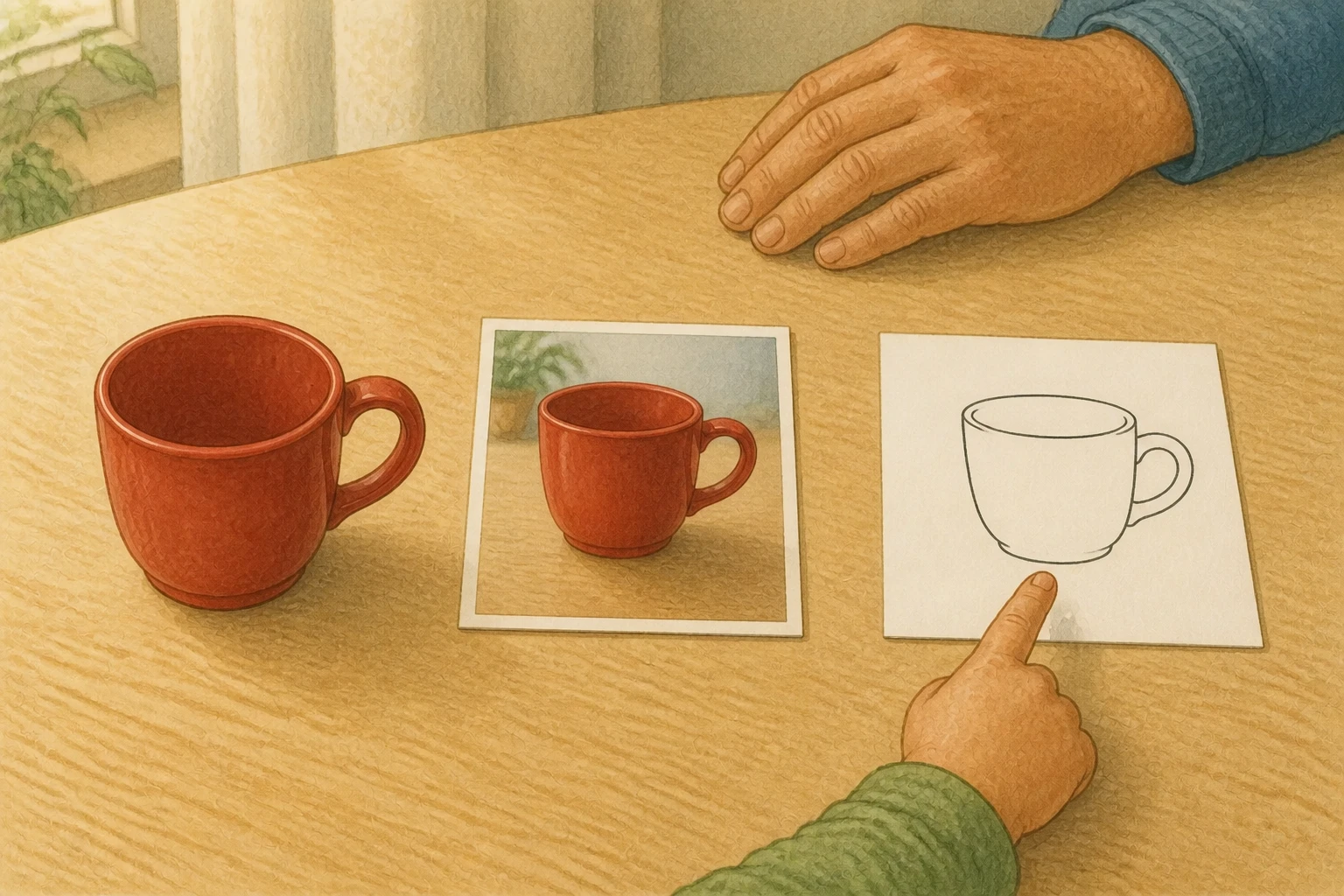
Pictograms — simple line drawings that stand for an object, an action or a place — are everywhere in autism support: on schedules, on communication boards, on the bathroom door. They are also handed out with almost no guidance about when a drawing is the right choice and when it is the wrong one.
The short version: a drawing is not automatically clearer than a photograph. Sometimes it is the harder image.
What simplification actually does
A pictogram removes detail. That is the point — no background, no shadows, no particular brand of cup, just the shape that says “cup”. For a child who is easily pulled toward irrelevant features of a picture, that is a real advantage.
But detail is also what makes something recognizable. A photograph of the family’s own red cup shares dozens of features with the actual cup on the actual table. A generic outline shares a few. For a child who has not yet learned that a picture stands for a thing at all, the photograph is the easier bridge, and the drawing is a second, harder step.
So the useful question is not “photos or pictograms?” but where is this child on the way from the object to the word?
The ladder
Four representations, roughly in the order many children find easiest to hardest:
- The real object. The actual cup means “drink”.
- A photograph of that object. A representation of the same thing, sharing most of its visual features.
- A drawing. Also a representation of the same thing, with most of the detail gone.
- The word, spoken or written. No physical resemblance at all.
This is one common progression, not a fixed sequence every child has to climb in this exact order — nobody has to visit every rung, and plenty of children arrive already at three or four. When something stops working, the rungs are a useful clue: a schedule that fails with drawings and works with photographs points toward which representation still needs work.
The step almost everyone skips
Here is the part that gets built on without being taught: a child can be perfectly fluent with photographs and have no idea that the drawing on the schedule stands for the same thing.
That link — this photo, that drawing, and the spoken word all point to one thing — is learnable, and it is learnable directly. Show a photograph and ask the child to find the drawing of the same thing among a few options. Then the reverse. Then a spoken word to either. Each step has a right answer, so you can see whether it is there instead of assuming.
This is exactly what our app does: it keeps a photograph and a drawing of the same concept and runs the crossing between them as its own exercise, with the help faded and the record kept. Printed cards on a table do the same job, more slowly and with you keeping the tally.
Cards ready to print
If the material is what you are missing, we have put together a free PDF with 54 routine cards to cut out: the morning, mealtime, the bathroom, getting dressed, bedtime, going out, how I feel and asking for things. The cards are photographs, and one sheet carries the six morning steps as drawings — which is exactly the crossing described above: the same activity in both formats, so you can see when your child is ready to make the jump.
It also has a board with six slots the exact size of the cards, and a blank sheet for photographs of your own. No sign-up and no email address.
Download the routine cards (PDF)
Choosing a set, and sticking to it
Which symbol set matters far less than using one. A child learns these drawings; swapping in a different style between the school folder and the fridge means learning them twice. Agree on one set with everyone around the child and keep the same symbol for the same thing everywhere it appears — while still checking, over time, whether the child can also recognize the concept in an unfamiliar symbol, since real-world materials will not always match your chosen set.
Two more practical points. Add the written word under every symbol from the start, even long before reading — it costs nothing and it is there when it starts to mean something. And keep the physical size and layout consistent: a child who scans a row of cards is helped by that row always looking the same way, whatever the number of cards happens to be.
One worry, answered
Parents ask, reasonably, whether giving a child pictures will make them stop trying to talk. The concern is understandable, and the research on augmentative and alternative communication does not support it: children given a way to make requests with pictures do not, as a group, end up talking less for having it — several studies report speech gains alongside it instead. What a picture system does is give a child who cannot yet ask a way to ask, which tends to reduce the frustration that comes from not being understood.
Further reading
- Our readiness check — three questions, one minute, no signup — for whether tablet-based practice suits your child right now.
- Matching activities for children with autism, the groundwork under every rung of the ladder.