Match-to-sample in ABA: a complete guide to running it and reading the data
Match-to-sample (MTS) is a conditional discrimination procedure: one stimulus — the sample — decides which of several comparison stimuli counts as correct on that trial. Change the sample and the correct answer changes with it. That single property is what separates it from simple discrimination, what makes it the standard arrangement for studying stimulus equivalence, and what makes it easy to run in a way that scores well while teaching something other than the relation you intended.
The PDF is made to print and hand out. Sharing by email links this page, so the link always points at the current version.

The guide in two minutes
- The sample is not decoration: it is what decides which comparison is correct on this trial.
- A high score is evidence about the procedure that produced it, and about nothing else on its own.
- A distractor that is also defensible under the stated relation turns one trial into two right answers.
- The correct answer must move position across trials, or the learner can score 100% on location.
- Equivalence is tested without feedback — feedback during a test is teaching, not measurement.
What is match-to-sample?
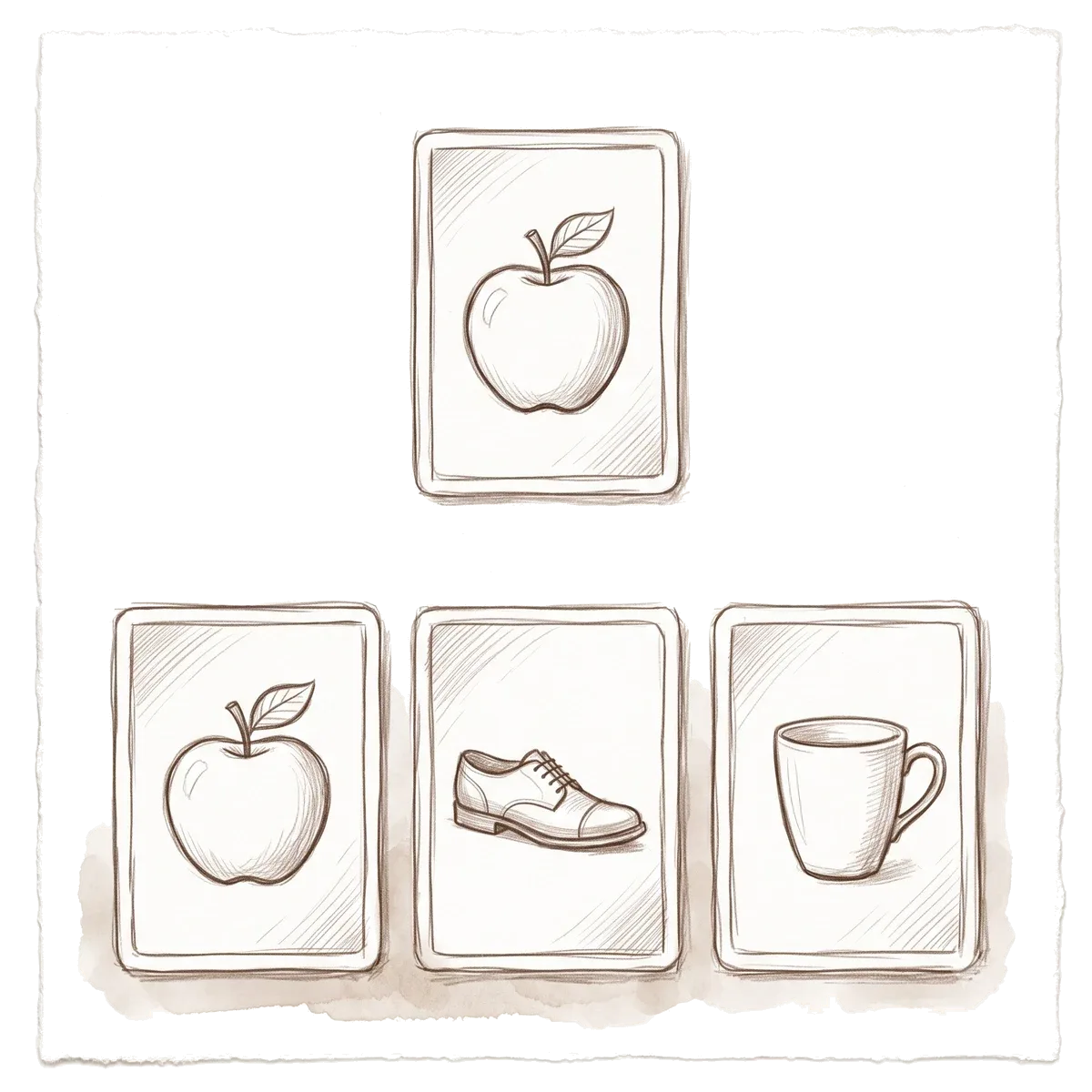
Match-to-sample is a procedure in which a sample stimulus is presented, then two or more comparison stimuli, and selecting the comparison that bears the programmed relation to the sample produces reinforcement. Because the sample determines which comparison is correct, it is a conditional discrimination rather than a simple one.
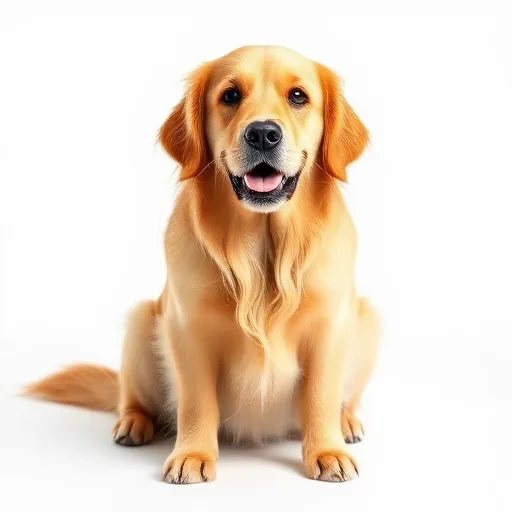
In a simple discrimination one stimulus is always correct: a red card is reinforced and a blue card is not, trial after trial. In match-to-sample nothing is correct on its own. A photograph of a dog is the right choice when the sample is a dog and the wrong choice when the sample is a cat. The comparison's function changes from trial to trial depending on what the sample is, which is exactly what the word conditional names. [1][2]


A distinction worth keeping
Concept, instance and stimulus are not synonyms
"Dog" is a concept. One particular photograph of a dog is an instance. That photograph becomes a stimulus when it takes a function in a trial — as the sample, or as a comparison — and affects the response. The image file on its own is not yet a stimulus.
The parts of a trial
A match-to-sample trial has five parts: the sample, the comparisons, the response, the consequence, and the interval before the next trial. Each has to be defined before the session, not decided during it.
-
Sample
The event that sets the criterion for this trial — a picture, an object, a printed word or a spoken word. It must be clear that the learner has looked at or listened to it.
-
Comparisons
The available options. One functions as correct for that sample; the others must be wrong without introducing a second defensible answer.
-
Response
Define it in advance: touching, pointing, handing over a card, placing an object. The definition has to let two observers score the same trial the same way.
-
Consequence
Follows the response according to the plan: reinforcement, feedback, or a neutral correction. On probes for emergent relations the feedback is withdrawn so the test does not teach.
-
Inter-trial interval
A short pause separating one opportunity from the next, so instructions, prompts and consequences from one trial do not bleed into the following one.
Types of match-to-sample
The main variants are identity, non-identical, symbolic or arbitrary, auditory-visual, delayed, compound, and equivalence probes. They differ in what the learner has to do, not only in how hard they look.
Scroll sideways to see the whole table.
| Variant | Example | What it requires |
|---|---|---|
| Identity | The same dog photo → the same photo | Discriminating shared physical features |
| Non-identical | One photographed dog → a different dog | Responding to class membership despite a change of exemplar |
| Symbolic or arbitrary | The written word "dog" → a picture of a dog | A learned relation that does not rest on physical resemblance |
| Auditory-visual | Hearing "dog" → choosing its picture | Holding an auditory sample while discriminating visual options |
| Delayed | The sample disappears before the comparisons appear | Retaining information across the delay |
| Compound | "Blue shirt" → choosing between blue shirt, red shirt and blue hat | Attending to more than one relevant feature |
| Equivalence probe | After training A-B and B-C, testing B-A, A-C or C-A | Showing relations that emerged without being taught |
Easy to conflate
Identity is the same image, not merely a similar one
A photograph matched to a drawing of the same thing is non-identical matching, and it asks a different question: it requires responding to what the two share as members of a class rather than to a physical copy. Calling both "identity" hides the step the learner actually took.
What to prepare before you start
Before the first trial, decide the relation, check access, pick clean instances, build valid comparisons, decide the consequence, and plan the recording. Anything left undecided will be decided mid-session in the learner's disfavor.
Preparation checklist
-
Define the relation
Write down what should control the selection: identity, category, word-to-picture, sound-to-picture, or another specific correspondence.
-
Check access
The learner has to be able to look, listen and respond in the chosen format. If there is a motor or sensory barrier, change the access, not the goal.
-
Choose clear instances
Start with visible differences, and without backgrounds, sizes or ornaments that give the answer away by accident.
-
Build valid comparisons
No distractor may also be correct under the stated relation. Two dogs on screen for "choose an animal" is two defensible answers.
-
Decide the consequence
Make sure the reinforcer is valuable at that moment, and that error correction is defined before the session rather than improvised.
-
Plan the record
Separate at least independent correct, prompted correct, and error. Add the position chosen so position bias becomes visible.
Designing an activity step by step
Pick a small set of concepts, decide the number of comparisons, rotate the correct position, interleave the concepts, and fix how many opportunities each one gets before you begin.
-
Choose a small set
Three to five concepts is enough to start. A larger pool spreads the opportunities so thin that no single relation gets enough trials to be learned.
-
Set the number of comparisons
Two comparisons give a 50% hit rate by chance; three give 33%. More options make chance less flattering, but only if every extra option is a valid distractor.
-
Rotate the correct position
If the answer sits in the same slot the learner can score perfectly on location and never look at the sample. Vary it deliberately rather than at random.
-
Interleave the concepts
Running every trial of one concept together lets the learner answer the block correctly after the first trial without consulting the sample again.
-
Fix the dose in advance
Decide the opportunities per concept and the session length before starting, so the stopping point is not chosen by how the session happens to be going.
The commonest silent failure
A fixed position teaches position
"Always the left card" scores 100% and demonstrates nothing about the relation. Any generator that produces trials automatically has to rotate the correct index itself; recording which position was chosen is what makes the bias visible in the data instead of invisible in the score.
Prompts, feedback and error correction
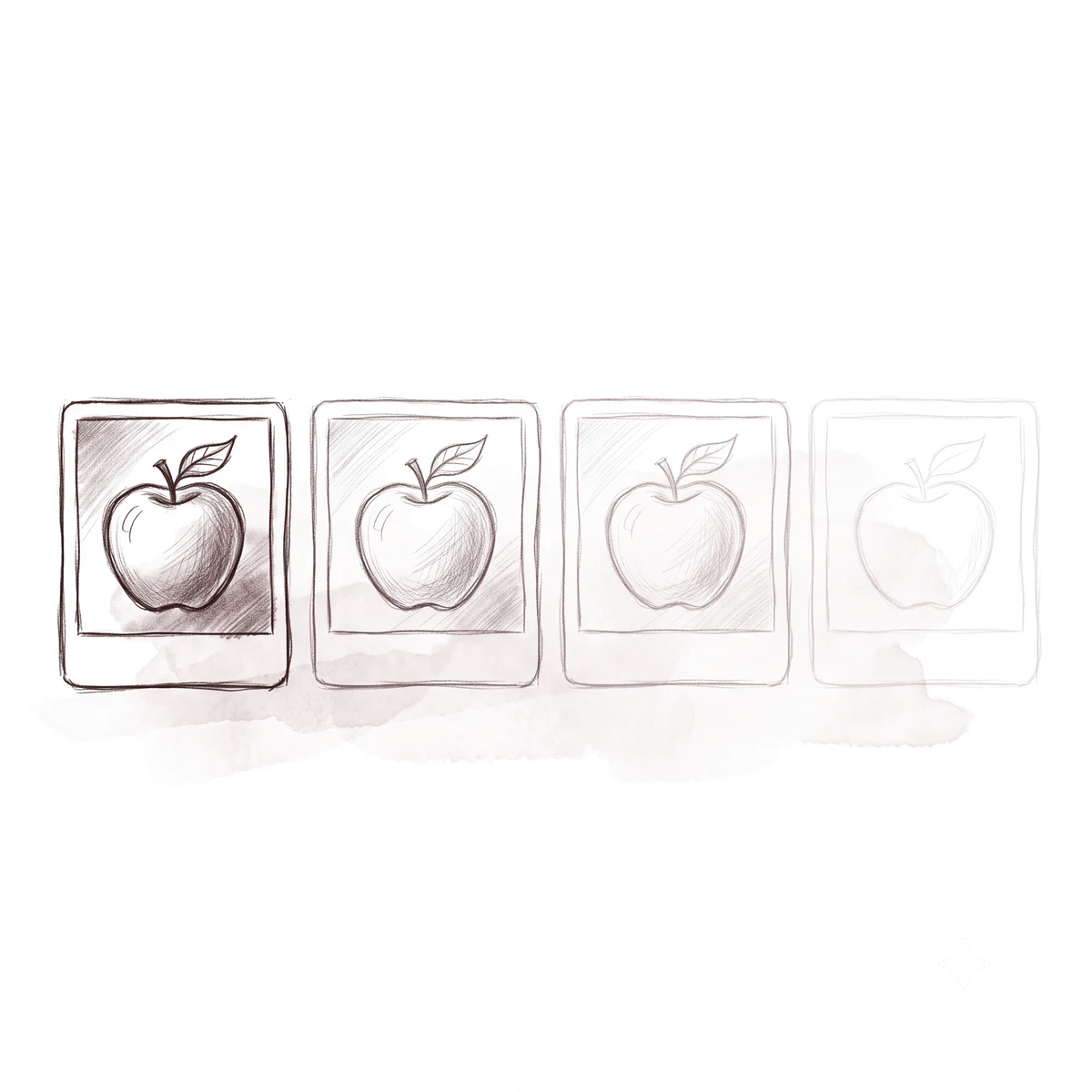
Prompt so that early errors are unlikely, fade against a criterion decided in advance, and define the error correction before the session. A prompted correct response is recorded as prompted, never as independent.
Errorless approaches arrange the first trials so the correct comparison is easy to select — the distractors are dimmed, smaller, or further away — and then reduce that help step by step. The reason is not only that errors are unpleasant: an error that is repeated becomes a pattern to unlearn later. Where the field does not converge is on the exact fading rule, so state whose rule you are using rather than presenting one as settled. [4][5]
Keep the two records apart
A prompted correct is not evidence of the relation
If prompted and independent responses share a column, the percentage measures the adult's help as much as the learner's discrimination. Mastery criteria should count independent correct responses only — otherwise a fully prompted session can read as a mastered one.
What to record and how to decide
Record independent correct, prompted correct, error, the position chosen and the response latency. Decide advancement against a criterion written before the session, and re-read it against the same population of trials each time.
The minimum record
-
Response class
Independent correct, prompted correct, error. Three columns, never two — the distinction is the whole point.
-
Position chosen
The only way position bias shows up as data rather than as a score you cannot explain.
-
Latency
Measured from the comparisons appearing, not from the trial starting. On a delayed trial the two are different numbers.
-
The criterion in force
A percentage means nothing without the denominator and the trial class it was computed over.

Common mistakes and how to correct them
The frequent failures are two defensible answers on screen, a fixed correct position, blocked concepts, prompts folded into the score, and a probe run with feedback.
Scroll sideways to see the whole table.
| What happens | Why it scores well anyway | The correction |
|---|---|---|
| Two distractors satisfy the relation | Either choice can be defended, so the trial cannot be scored | State the relation in one sentence and test every distractor against it |
| The answer is always in the same slot | Location is a simpler discrimination than the relation | Rotate the position and record which slot was chosen |
| All trials of one concept run together | The first trial answers the rest of the block | Interleave concepts within the session |
| Prompted and independent share a column | The help is counted as the learner's performance | Score the three response classes separately |
| The probe gives feedback | The test teaches while it measures | Withdraw feedback and correction on every probe |
| A background or size gives it away | An irrelevant feature is doing the work | Equalize the instances on everything except the relevant dimension |
Match-to-sample and stimulus equivalence
Match-to-sample is the standard arrangement for testing stimulus equivalence. After training some relations directly, others are tested without feedback; when those untrained relations hold, the stimuli are behaving as members of one class.
Sidman and Tailby set out the properties an equivalence class has to show: reflexivity (A matches A), symmetry (having trained A-B, B-A holds) and transitivity (having trained A-B and B-C, A-C holds). What makes the finding useful in practice is that the untrained relations are not taught at all — they are tested, and they either appear or they do not. [1][6]
Trained relations
Probes run without feedback

What a probe may and may not claim
A negative probe is not a verdict about the learner
A relation that does not hold on the test licenses an action about the teaching — more varied exemplars, or a re-test — rather than a conclusion about the child. Sidman notes that negative tests often turn positive on repetition, which is also why re-probing has to be planned rather than improvised.
A worked example with real objects
A first identity-matching activity with three everyday objects, three comparisons, rotated positions and a written criterion, run in about ten minutes.
-
Materials
Two identical copies of three objects the learner already handles — a spoon, a cup and a sock. Six items in total, so the sample can be matched to a physically identical comparison.
-
The arrangement
Three comparisons on the table, well separated. Hand over or place the sample; wait for the learner to look at it before the response is available.
-
The relation, written down
"Choose the object that is the same as the one I am holding." Everything else — colour, position, which hand — is irrelevant and has to be equalized.
-
The first trials
Start with the correct comparison slightly closer, then move it back into line once two consecutive independent correct responses have happened.
-
The record
One line per trial: sample, position chosen, response class. Twelve trials, four per object, interleaved rather than blocked.
-
The decision
Advance when the criterion you wrote before the session is met on independent trials only. If it is not met, the next change is to the teaching, not to the criterion.

Common questions about match-to-sample
Which task is an example of a match-to-sample activity?
Placing a picture with its identical match from a group of pictures. What makes a task match-to-sample is that a sample is present and the correct comparison depends on it: change the sample and a different comparison becomes correct. Imitating a clapping motion is imitation, and following a three-step instruction is instruction-following — neither has a sample that decides which response is correct. Choosing an object after hearing its name is also match-to-sample, with the spoken word as the sample, which is why picture-to-picture matching is the clearest example rather than the only one.
What is the primary goal of teaching match-to-sample tasks in a behavior acquisition program?
To teach the learner to scan a set of options and discriminate between them: look at the sample, compare it against each comparison, and choose on that basis. Labeling objects, responding to spoken instructions and following multi-step directions are separate repertoires that a match-to-sample program does not train directly. What the score demonstrates is conditional discrimination — that the choice was governed by the sample — and it demonstrates nothing else on its own.
Is match-to-sample the same as matching?
"Matching" is often used loosely. Match-to-sample is the precise term when a sample determines which of several comparisons is correct. Putting two identical objects together with nothing functioning as a sample can be a matching activity, but it is not necessarily a conditional discrimination.
How many comparisons should a trial have?
Two comparisons give a 50% chance hit rate and three give 33%, so more options make a high score harder to reach by guessing. The limit is that every extra option must be a valid distractor — an option that is also defensible under the stated relation makes the trial unscorable however many there are.
What is delayed match-to-sample?
A variant in which the sample is removed before the comparisons appear, so the learner has to retain the information across the delay. It measures something different from the simultaneous version, and response latency has to be measured from the comparisons appearing rather than from the start of the trial, or the delay is counted as part of the learner's response time.
Why should the correct answer change position?
Because position is a simpler discrimination than the programmed relation. If the answer always sits in the same slot, selecting that slot scores 100% without the sample ever being consulted, and the score gives no way to tell the two apart.
Can a high percentage mean nothing was learned?
It can mean something other than the intended relation was learned. Position, an irrelevant feature such as a background, a prompt that was never fully faded, or a blocked trial order all produce high scores. This is why the trial design and the probes matter as much as the final percentage.
What is a probe, and how is it different from a teaching trial?
A probe is a handful of trials run with no help and no feedback, usually on material the learner has not practised. Withdrawing the feedback is what makes it a measurement: a test that corrects errors is teaching during the test, and the result then describes the test rather than what the learner brought to it.
When is a learner ready for symbolic matching?
Symbolic matching relates stimuli that share no physical features, so it usually rests on identity and non-identical matching being solid first. In practice the sequence is checked rather than assumed: if symbolic trials stall, the useful question is whether the earlier relations hold with untrained exemplars.
How does match-to-sample connect to reading?
Sidman's early work used auditory-visual match-to-sample to relate spoken words, pictures and printed words. When those relations form a class, some reading-related relations can be observed on a test without having been taught directly — which is an observation about what emerged, not a claim that reading was taught.
References
- Sidman, M. (1971). Reading and auditory-visual equivalences. Journal of Speech and Hearing Research, 14(1), 5-13. DOI
- Sidman, M., & Tailby, W. (1982). Conditional discrimination vs. matching to sample: An expansion of the testing paradigm. Journal of the Experimental Analysis of Behavior, 37(1), 5-22. DOI
- Sidman, M. (1994). Equivalence relations and behavior: A research story. Authors Cooperative. DOI
- Terrace, H. S. (1963). Discrimination learning with and without "errors". Journal of the Experimental Analysis of Behavior, 6(1), 1-27. DOI
- Green, G. (2001). Behavior analytic instruction for learners with autism: Advances in stimulus control technology. Focus on Autism and Other Developmental Disabilities, 16(2), 72-85. DOI
- Sidman, M., Willson-Morris, M., & Kirk, B. (1986). Matching-to-sample procedures and the development of equivalence relations: The role of naming. Analysis and Intervention in Developmental Disabilities, 6(1-2), 1-19. DOI
- Ledford, J. R., & Gast, D. L. (2018). Single case research methodology: Applications in special education and behavioral sciences (3rd ed.). Routledge. DOI
To print and share
Take the whole guide with you as a PDF
The downloadable version keeps the sections, tables, examples and references from this page.