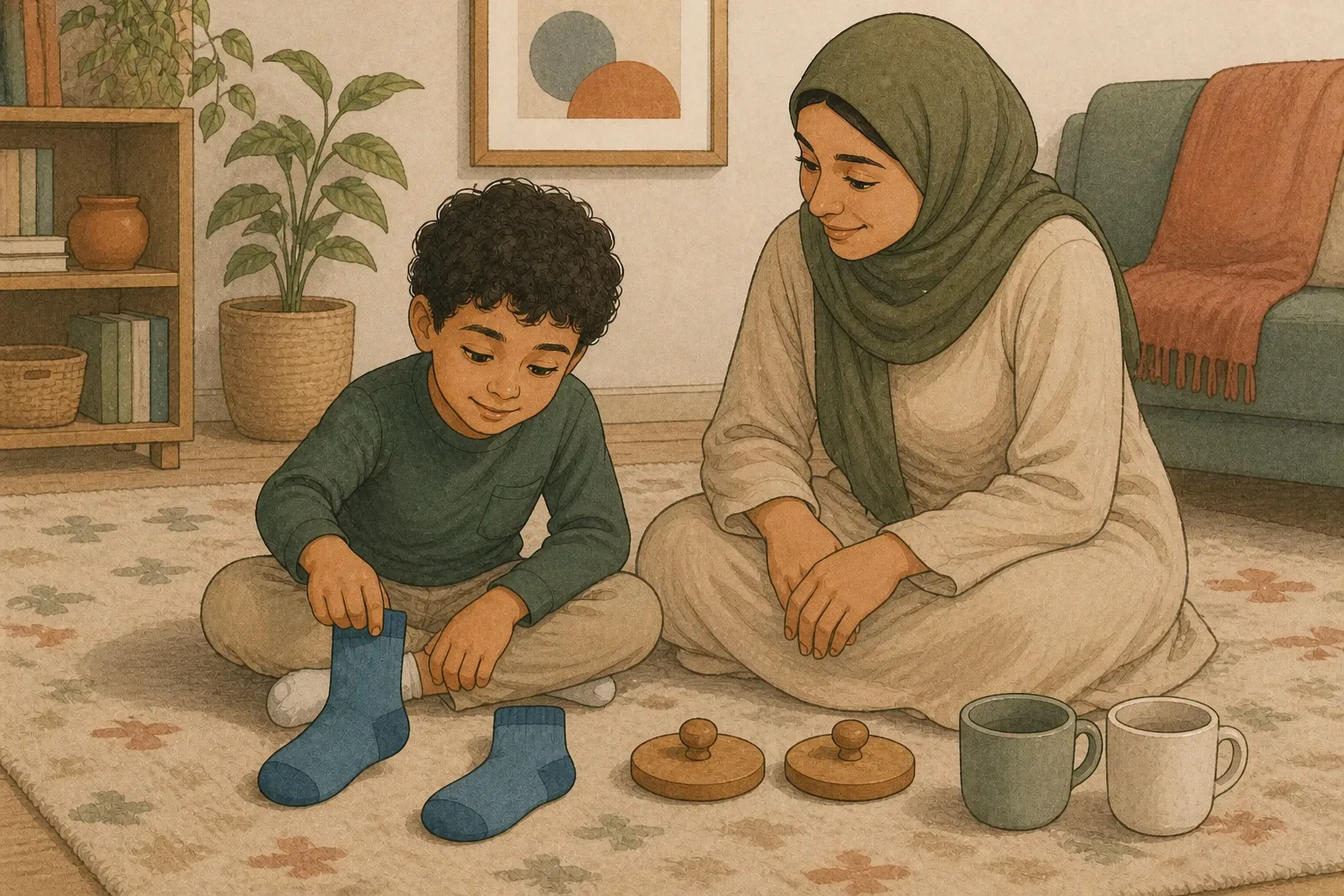
If you’re searching for “matching activities”, chances are someone — a teacher, an instructor, another family — told you they’re a good starting point for your child. It’s good advice. Matching is one of the most studied skills in early learning, and for many children with autism it’s the doorway to vocabulary, categories, and language.
This article covers what a matching activity actually is, why it works, and how to start at home with no special materials.
What matching is (and what it isn’t)
A matching activity is simple: the child sees one thing — a photo, an object, a drawing — and picks, from several options, the one that “goes with” it. A dog with another dog. A toy apple with a photo of an apple. The written word “sun” with a drawing of the sun.
What matters isn’t getting one particular card right — it’s learning the relation between the two things. When that happens, the child starts responding to the concept — any dog, not that dog — and the skill transfers to things they’ve never seen. That’s why professionals call this procedure match-to-sample: it’s the same game, studied scientifically for decades.
What matching is not: memorizing. If your child always sees the same two cards in the same order, they’ll learn where the answer is, not what it means. Variation is what turns the game into learning.
Why it’s the best starting point
- It doesn’t require language. Your child doesn’t have to say “dog” to show you they understand what a dog is. Matching lets them learn — and show you what they know — before they speak.
- It can be errorless. Starting with very easy choices (the correct one plus a very different distractor), the child succeeds almost every time. Consistent success prevents the frustration that usually derails these activities at home.
- It scales on its own. The same format works for colors, animals, emotions, letters, numbers, and sounds. Learn the game once and it serves you for years.
Four formats to start at home
Each of these needs a real choice to actually teach anything — your child touches the correct match next to at least one clearly different option, not just the one matching item on its own.
Figure — Four matching formats
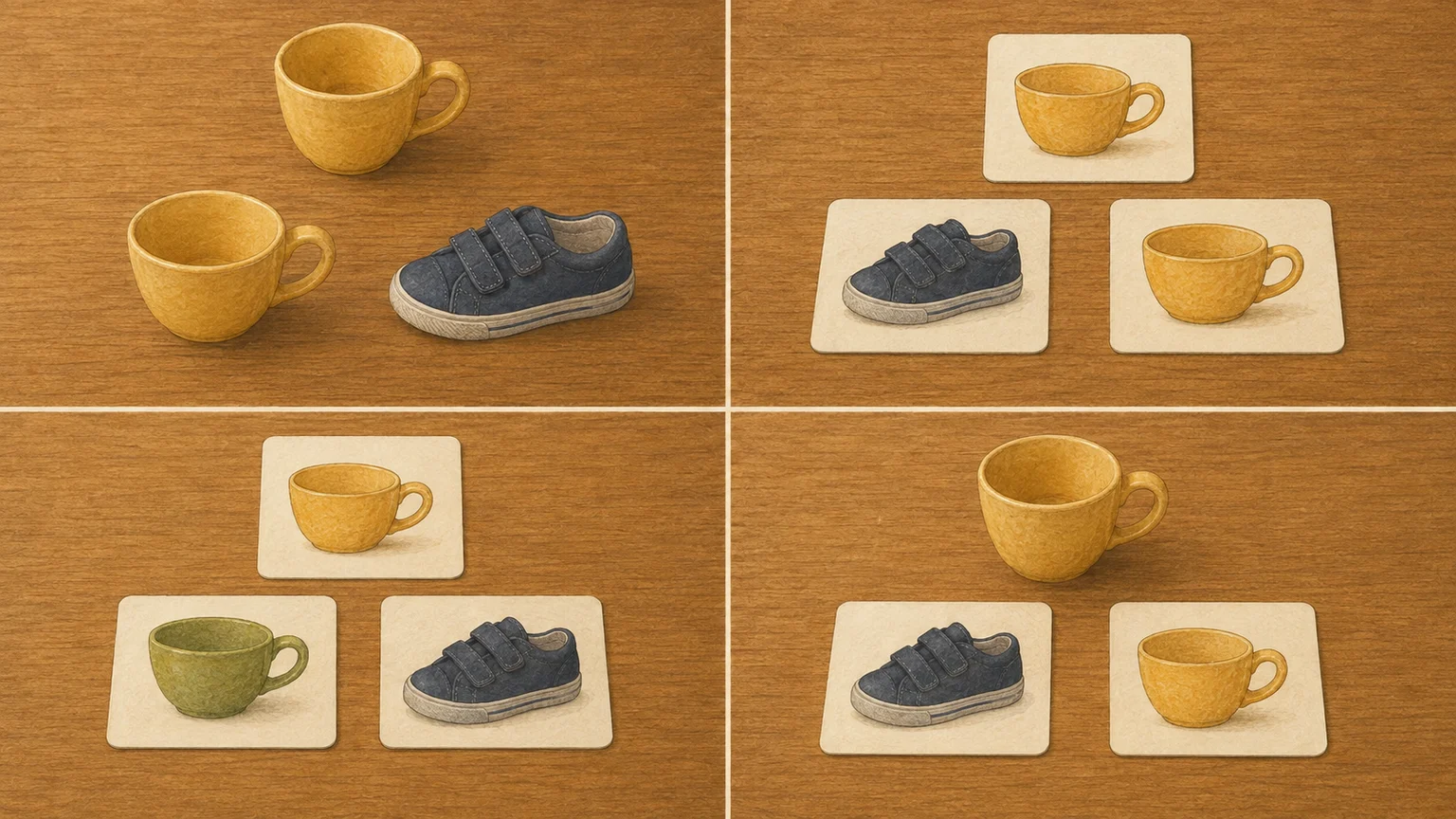
Object to identical object. Two identical spoons, plus something clearly different (a ball) as the other option. Put the sample in front of your child and say “put with same.” Celebrate every success.
Object to photo. A real spoon next to a photo of a spoon and a photo of something else. This jump (from the thing to its image) is a huge step in symbolic development.
Photo to non-identical photo. A photo of a sheepdog matched against a photo of a chihuahua and a photo of a cat. This is a step toward matching by concept rather than appearance — though a different dog photo can still lean on plain resemblance (fur, four legs, the same general shape), so it isn’t proof on its own that appearance stopped mattering.
Word or sound to image. Hearing “dog” and touching the photo of the dog, next to a photo of something else. This is receptive vocabulary — the foundation of language comprehension.
Two things that make the difference:
- Distribute the correct answer’s position unpredictably. If it’s always on the right, your child will learn “right”, not the concept — and with only two options, switching sides every single round can just as easily teach “alternate”, which is its own kind of pattern the answer doesn’t ask for. Keep it genuinely unpredictable, and mix in different concepts within the same short session rather than running many rounds of one thing before switching.
- Use many exemplars. Three different dog photos are worth more than one photo repeated ten times.
When an app helps
Doing this well by hand is trickier than it looks: you have to vary positions, mix exemplars, raise difficulty at just the right moment, and fade help gradually. That’s exactly what Interlaza automates: every round is designed so your child succeeds at first, prompts fade at their pace, and difficulty adjusts itself based on what they’re mastering. You can read how it works under the hood or try a ten-minute session at home.
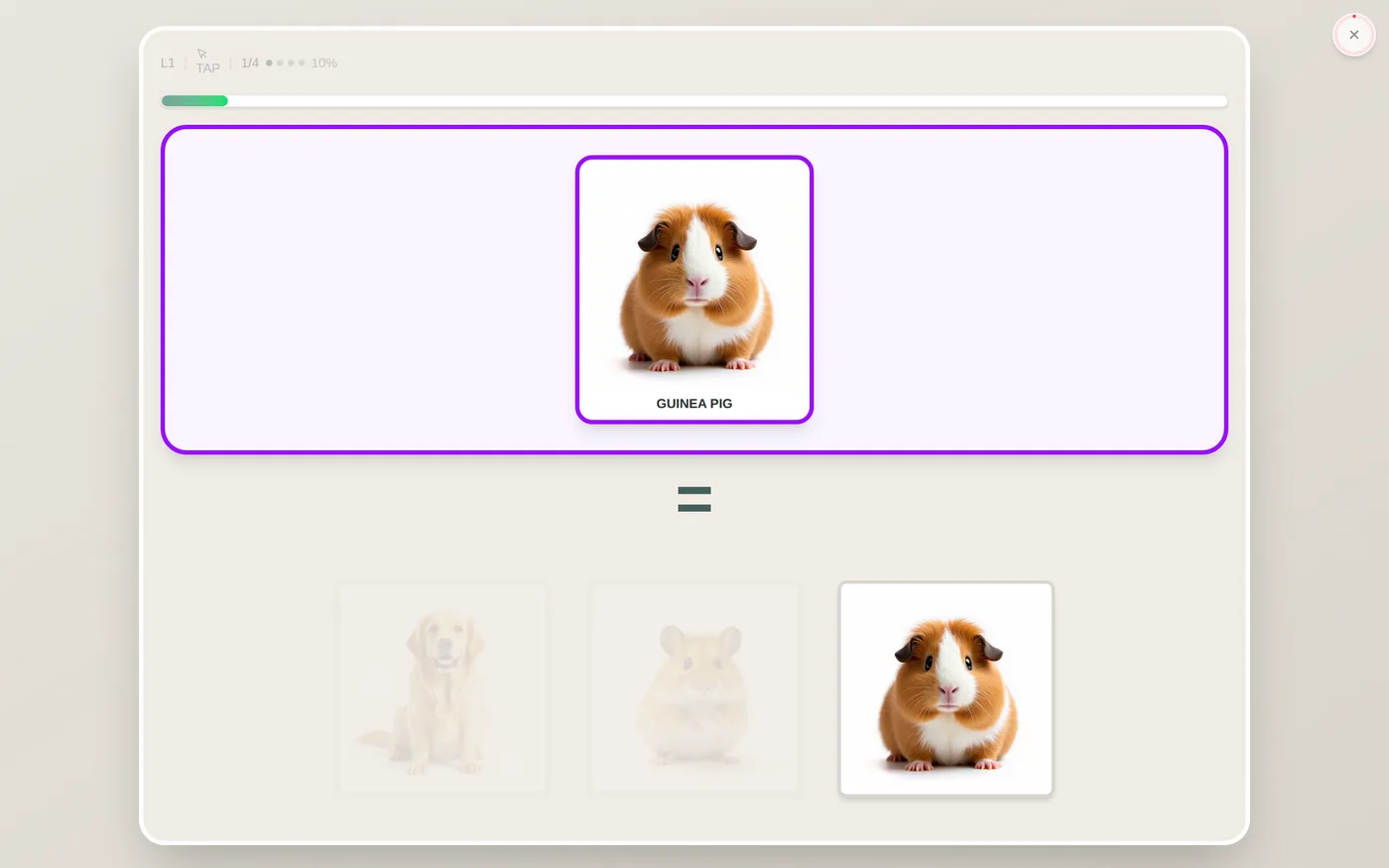
Table cards and the app don’t compete — they reinforce each other. Whatever your child learns on screen, practice it with real objects: that’s where the concept finishes generalizing to daily life.