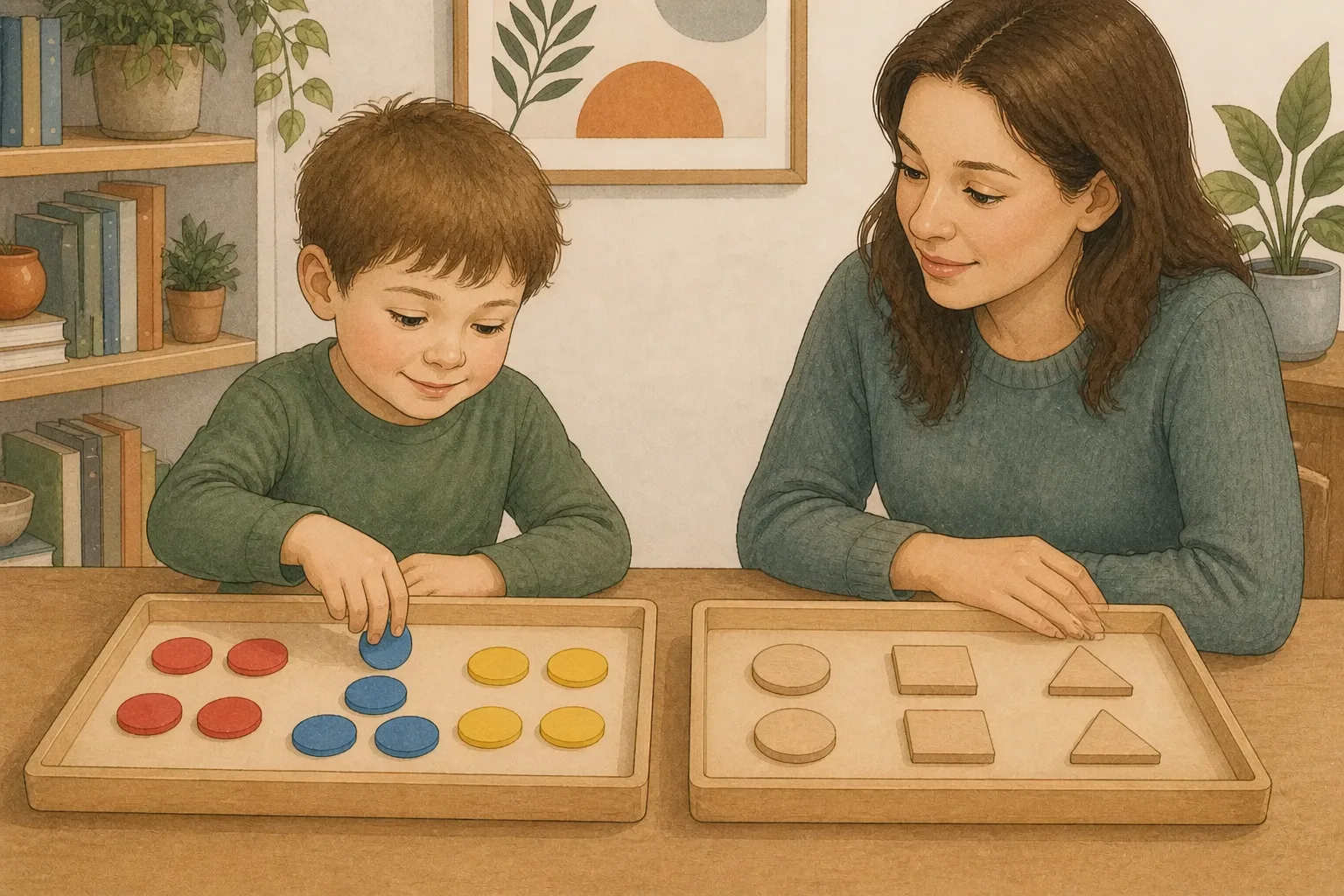
“He knows the puzzle by heart but won’t hand me the red piece when I ask.” Colors and shapes are among the first concepts we try to teach, and among the ones that get stuck most often. That’s no accident: they’re abstract concepts. A dog is a thing; “red” isn’t a thing, it’s a property that shows up in a thousand different things. This article explains why they’re hard and how to teach them well.
Why colors are harder than “dog”
When a child learns “dog”, every dog shares a general shape, legs, movement — though not necessarily an approximate size (a chihuahua and a great dane are both unmistakably dogs). When they learn “red”, they have to ignore everything else — the shape, the size, what the object is for — and attend only to the color. That’s called attending to one dimension of the stimulus, and it’s a real cognitive leap; it isn’t automatically a harder one than shape, which brings its own leap (see below).
Hence a rule worth building around: sorting by color is what shows the concept, more than touching one particular card does. Your child doesn’t necessarily know “red” just because they touch the same old red card correctly; grouping a red car, a red sock, and a red apple — objects that share nothing else — is stronger evidence.
An order that works
Match first, then recognize, then name is one path that works well, not the only sequence that gets there.
- Match (no words): “put with same” — the red block onto the red card. Requires no language and builds the pure discrimination.
- Recognize (comprehension): “give me red” — hear the word and choose among options.
- Name (expression): “what color is it?” — the last stage, never the first.
Starting with naming is the classic recipe for frustration. The silent matching in step 1 is exactly the match-to-sample procedure, and you can do it with blocks, bottle caps, or socks.
Concrete tips:
- Start with two strongly contrasting colors (red and blue), not the whole crayon box. Add the third once the first two are solid.
- Vary the object, keep the color. To teach “red”, use different red things, not always the same block.
- Beware the favorite-object trap: if “yellow” is always taught with the toy banana, they may be learning “banana”, not “yellow”.
- Give help at the start and withdraw it gradually — point, nudge the correct option closer, and fade the gesture. That’s errorless learning applied to colors.
- Distribute positions unpredictably and mix colors and objects within a session rather than running many rounds of one before switching — a strict left-right-left-right pattern with only two options teaches alternation, not the concept.
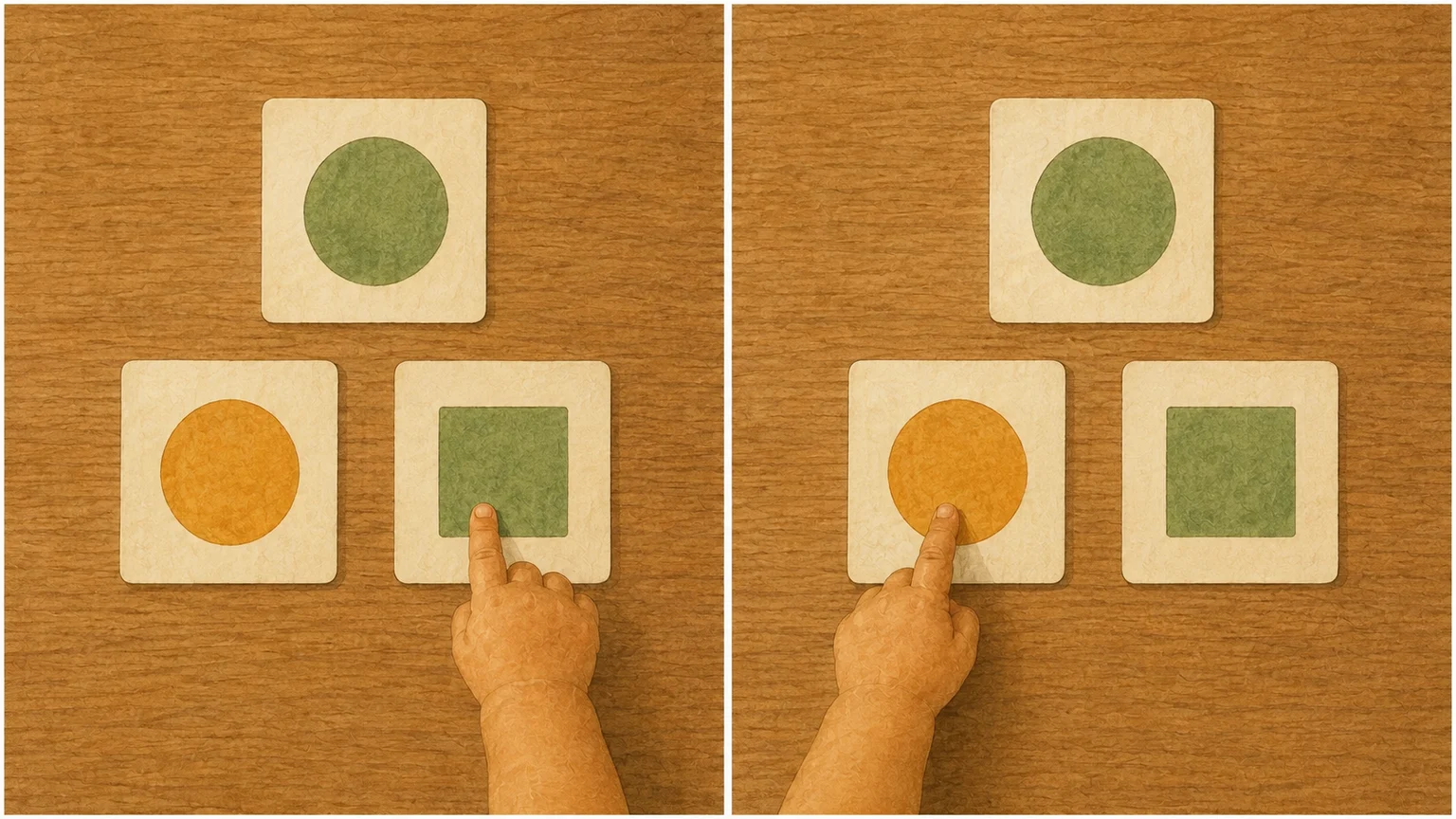
The favorite-object trap and the color-vs-shape confusion are really the same problem seen twice: the same four objects can be sorted two different ways, and only the question you ask decides which answer is correct.
Figure — The same sample, two explicit criteria
Shapes: the same path, one advantage
With shapes (circle, square, triangle) the process is identical — match, recognize, name — with one advantage: shape can be touched. Shape sorters and silhouette puzzles are physical matching with automatic feedback: the wrong piece won’t fit. If your child already masters a shape sorter, they’re already matching shapes; the next step is doing it with cards, where there’s no physical cue and the discrimination is purely visual.
One important nuance: a big circle and a small circle, blue or red — it’s all “circle”. Just as with colors, variation across exemplars is what separates the concept from memory.
When to worry (and when not to)
A two- or three-year-old mixing up colors is common. Research on color-term development (Pitchford & Mullen, 2006) finds consistent, adult-like color naming typically settling in between roughly 3 and 4 years old, precisely because representing color independently of the object it belongs to — the “dimension” leap described above — takes children longer to build than most early vocabulary. That is a typical range from one line of research, not a number to hold your own child to. The useful signal isn’t age but pattern: if they match perfectly but don’t respond to the word (“give me red”), that pattern points toward auditory comprehension as the piece to work on next — it doesn’t rule out other explanations on its own (attention, the specific word, the request itself), so read it alongside what else you’re seeing, not as a diagnosis. Knowing roughly which step your child is on is still most of the solution.
Here is the whole method as the sequence you follow at home:
How Interlaza helps
Colors and shapes demand systematic variation of examples, and that is where a prepared library and recorded probes — trials run with no help and no feedback, checking whether a relation holds beyond what was directly trained (not always on brand-new material) — make a practical difference. Interlaza can present color and shape relations across different objects, fade configured support and preserve which examples were taught or kept novel. The Family plan’s guided pathway sequences matching, recognition and later checks without claiming that the app can infer a concept from one pattern alone.
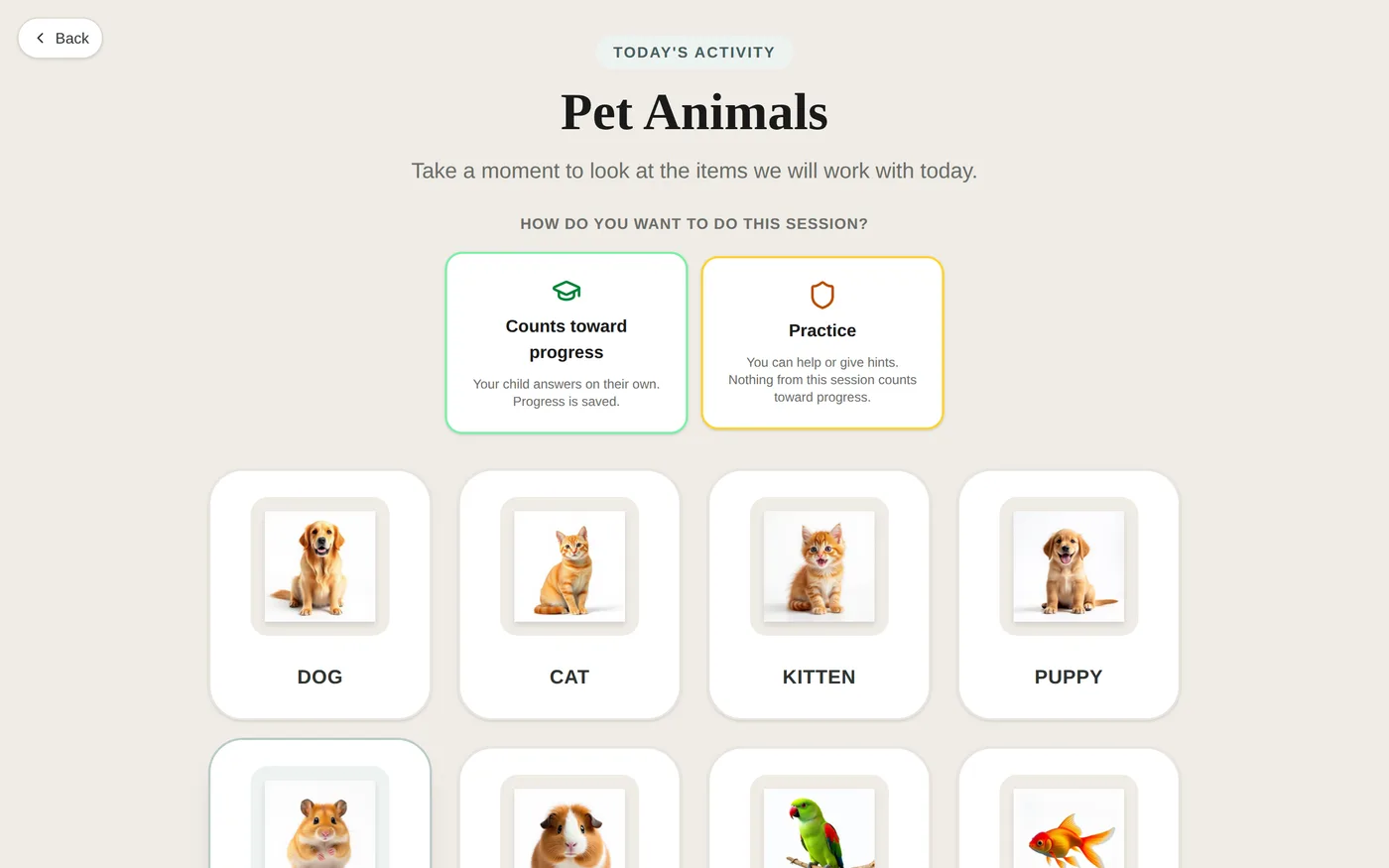
And as always, screen performance needs another question at home. “Give me the red cup” at snack time is not worth a fixed number of trials; it is different evidence, in a more natural context.