
Skinner’s insight, and it is genuinely the useful one for teaching, is that language is not a vocabulary list. The same word can be several different behaviors depending on what occasions it and what it produces, and there is no guarantee that teaching one carries over to the rest.
The tact is naming what is present. A dog walks past, the child says “dog”, and what follows is social: you look, you agree, you say something back.
Why the same word is two skills
A child who says “cookie” because they want one is doing something controlled by their own state — they are hungry, the cookie is the point, and the reinforcer that maintains it is getting the cookie.
A child who says “cookie” while looking at a picture of one in a book is doing something controlled by the picture itself, not by hunger — a non-verbal source of control. Nothing is being obtained in the sense of getting a cookie; what maintains it is a generalized reinforcer: attention, agreement, someone saying something back.
Two different sources of control, two different kinds of consequence. That is one reason a child can request a dozen items fluently and still not name any of them, and why the reverse also happens — though the split is not always clean: a response can be under more than one source of control at once, and “cookie” said to a picture while the child also happens to be hungry may be doing a bit of both. Neither pattern is a failure of generalization — the two were never guaranteed to be the same skill.
Figure — The same word can serve different functions
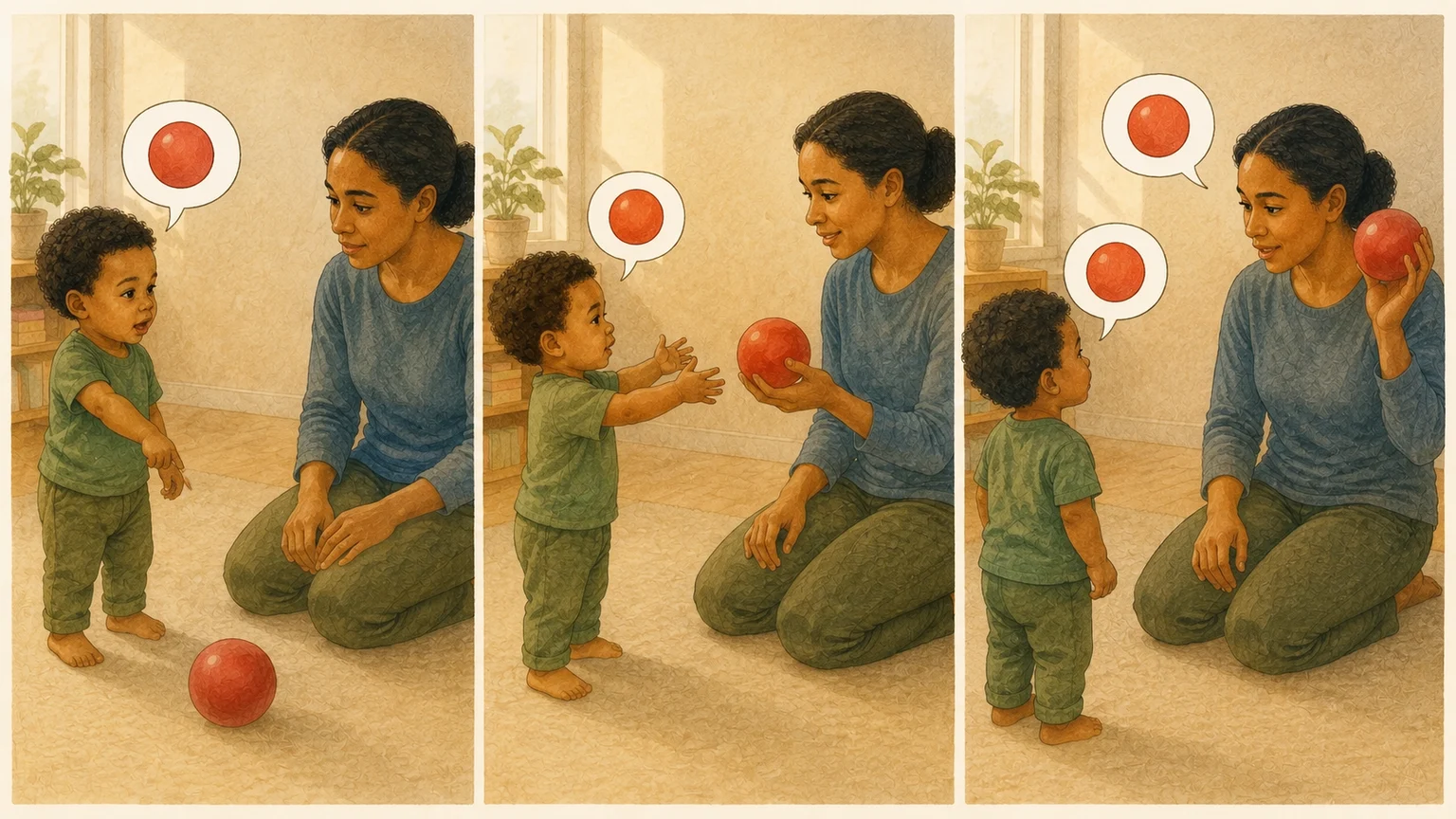
- Sees the ball → says “ball” → social response
- Wants the ball → says “ball” → receives the ball
- Hears “ball” → says “ball” → adult response
The mistake that erases the difference
Hand over the item every time the child names it, and the contingency you have built — say the word, get the thing — is what teaches a mand, whatever you intended to be teaching. That does not mean a correctly-taught tact goes unconsequated: attention, agreement, a reply back are consequences too, just a different kind, and getting them is still obtaining something. The difference is what the response depends on getting, not whether it gets anything at all.
Reinforce a tact the way a person would: look, respond, say something back, be interested. If the child clearly wants the item, that is fine, but then you are working on the request, and it is worth knowing which one you are doing.
Where to teach them
The obvious place is a table with pictures, and that works. It is also the place where a tact most easily becomes a rote answer to a rote prompt — “what is it?” repeated forty times produces a child who names things when asked that exact question, in that chair.
The better half of the work happens during the day, where the things already are. Name what you both see and leave room. Ask less than you think you should: “what is it?” is a prompt, and a tact that only occurs after that prompt has not yet come under the control of the thing itself.
What the record should show
If a program is teaching both requests and labels, the record has to keep them apart — the same word counted in one column tells you nothing about which one is growing.
Interlaza records free-operant responses with the operant kept separate, along with whether the response was independent, prompted, or a partial approximation. That last one matters: a partial word is submitted as not correct, so it can never satisfy a mastery criterion, but it is reported separately rather than being filed as an error. A child moving from silence to an approximation is doing something, and a record that shows only right and wrong cannot see it.
Further reading
- Stimulus equivalence — how naming and matching start to feed each other.
- ABA therapy activities — where naming fits among the other things worth practicing.