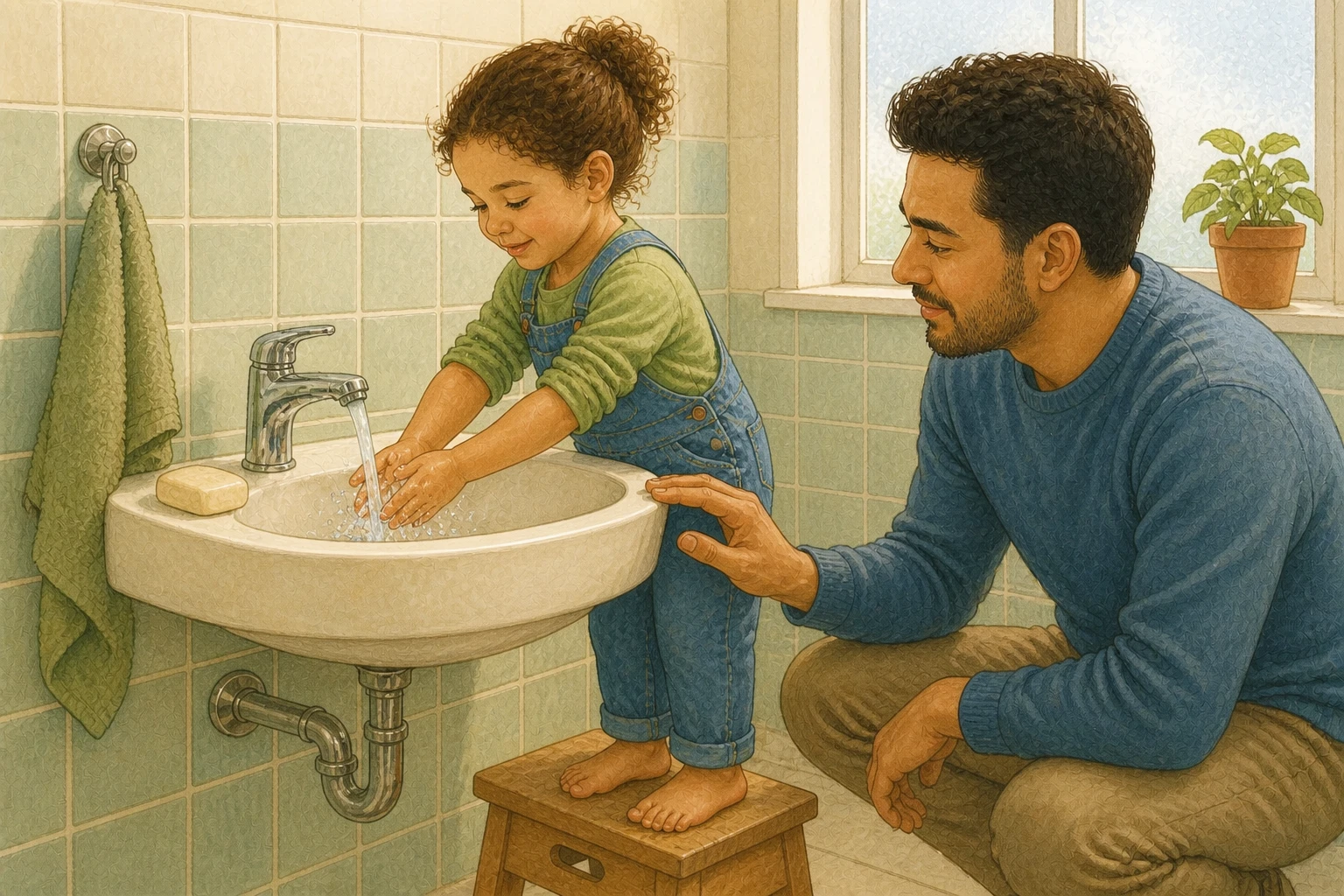
Washing hands is one thing to an adult and about eleven things to a child learning it. Task analysis is the unglamorous work of writing down which eleven, and chaining is how you teach them so they end up feeling like one activity again.
Both are old, plain and reliable, and both are usually done badly in the same way: the step list is copied from somewhere instead of observed.
Writing the step list
Do the routine yourself, slowly, and write down each action separately. Not what you would say — what you do. Then watch the child attempt it and adjust: a step they sail through can be merged with its neighbor, a step where they stall probably contains two steps.
That is the whole method, and it is why two children learning the same routine can legitimately have different lists. Handwashing might be six steps for one child and twelve for another. The list belongs to the child, not to the skill.
One useful check: could a stranger follow your list and produce the routine, without guessing? If a step says “wash hands properly”, it is not a step yet.
What a list written this way looks like
Handwashing, for a three-year-old who reaches the sink on a step stool:
- Climb onto the stool.
- Turn on the tap.
- Wet both hands.
- Pick up the soap.
- Rub the palms together.
- Rub the back of each hand.
- Rub between the fingers.
- Put the soap down.
- Rinse both hands.
- Turn off the tap.
- Dry with the towel.
This list is an example, not a template. For a child who needs no stool it is ten steps; for a child who does not yet separate rubbing from rinsing, “rub the palms” and “rub the back of each hand” are one step while they learn it, and “rinse both hands” is two. The test is not whether your list resembles this one — it is whether every line names an action the child can attempt.
The three chains
Forward chaining. Teach step 1 to independence, prompting the rest through. Then steps 1-2. And so on. The child’s independent work sits at the beginning of the routine.
Backward chaining. Prompt every step through except the last, which is the one being taught — it can still need help at first, and its prompt fades the same way as any other step’s. Then the last two. And so on backwards. The child’s independent work grows from the end, which means every practice run finishes on the step being taught, immediately followed by the natural payoff of having finished.
Total task. Run the whole routine every time, prompting whichever steps still need it and fading each one separately. Nothing is postponed; the child gets the shape of the whole routine from the start.
None of the three is the advanced one, and picking one is less about the task’s shape than about what the baseline below shows for this particular child. Total task suits a child who can already do several of the steps; backward suits a routine with a clear reward at the end (getting the shoe on, eating the sandwich), for a child who tolerates being prompted through the earlier steps; forward suits a routine where the early steps are the hard ones and the end is trivial.
Figure — One routine, three ways to teach it
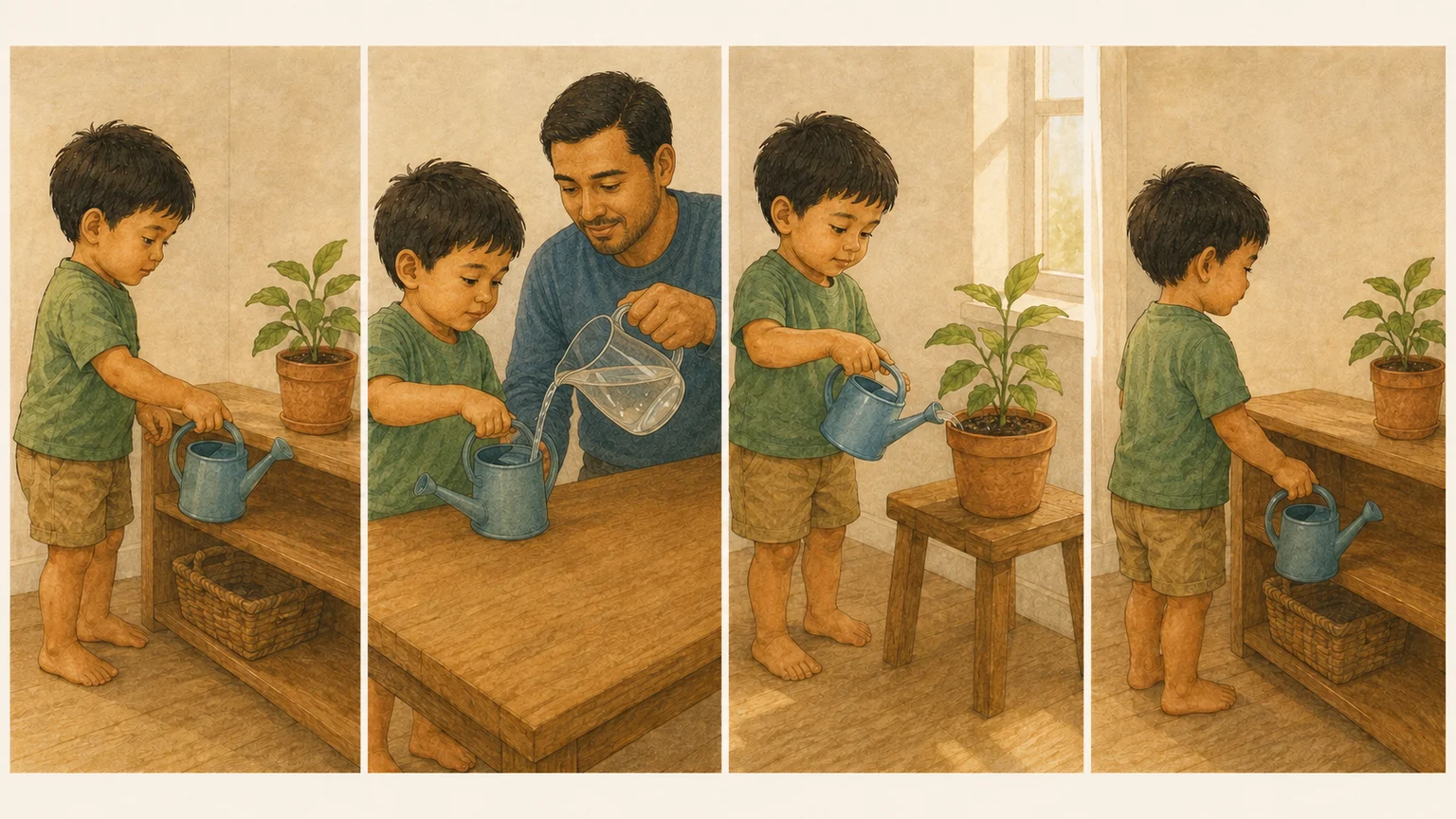
- Steps: pick up → fill → water → put away
- Forward: begin with the first step and add later steps; assist or complete the remaining steps as needed.
- Backward: assist or complete the initial steps and teach the last step first, then add earlier steps.
- Total task: offer practice in every step and help where needed.
The step that saves the most time
Run the routine once before teaching anything — help wherever help is needed, and mark each step independent or not. One run is a useful starting sample, not a stable baseline in the strict sense (that takes several observations), but it is enough to stop you teaching a step the child can already do.
Often the child can already do more than expected, sometimes most of the middle, and the teaching collapses to fewer steps than planned. Skipping that first run is how a program ends up spending weeks prompting a child through things they could already do.
What Interlaza does with this
The app carries chaining routines that run one step at a time on their own screen — the step is shown, the adult marks it, and the record keeps which steps are independent. It sits as its own row under Teach a child rather than as a pathway stage: a routine runs step by step on its own screen and stays outside a route’s stage-by-stage progression.
What the app cannot do is write your step list. That comes from watching this child do this routine, and no software has seen either.
Further reading
- ABA therapy activities — the direct-teaching half of a program, beside the routines.
- Visual schedules for autism — for the routine above the routine: what comes next.