
TEACCH began at the University of North Carolina in the 1960s as Treatment and Education of Autistic and related Communication-handicapped Children — an expansion whose wording reflects the decade it was coined, which is one reason the program itself is mostly known by the acronym now. It became a way of organizing classrooms and homes that is now used far beyond UNC. It is usually described as structured teaching, and that name is more useful than the acronym.
It is also routinely misunderstood in both directions: as “just visual supports” with nothing behind them, or as a complete alternative to teaching that never builds a new skill. Neither is right — UNC’s own description pairs structured teaching with individualized teaching strategies, not the environment on its own.
The idea underneath it
The starting claim is that many autistic children process what they see more readily than what they hear, and that a great deal of daily difficulty comes from not knowing what is expected. So instead of explaining the expectation over and over, you build it into the environment, where it stays put and does not depend on anyone remembering to say it. That premise is a starting point for the program, not a diagnosis of any one child — which visual supports actually help this child, and how much, is worked out for them, not assumed from an autism label.
Put differently: the adult’s instructions are replaced, wherever possible, by arrangements. That is the whole method in one sentence.
The four kinds of structure
Physical organization. Areas that mean one thing. This table is for work; that corner is for a break; the mat is where the group sits. Boundaries are visible, and distractions are placed out of the line of sight rather than out of the room.
A schedule. What happens now and what comes next, in pictures, objects or words depending on the child. Not a timetable on the wall for the adults — something the child moves through.
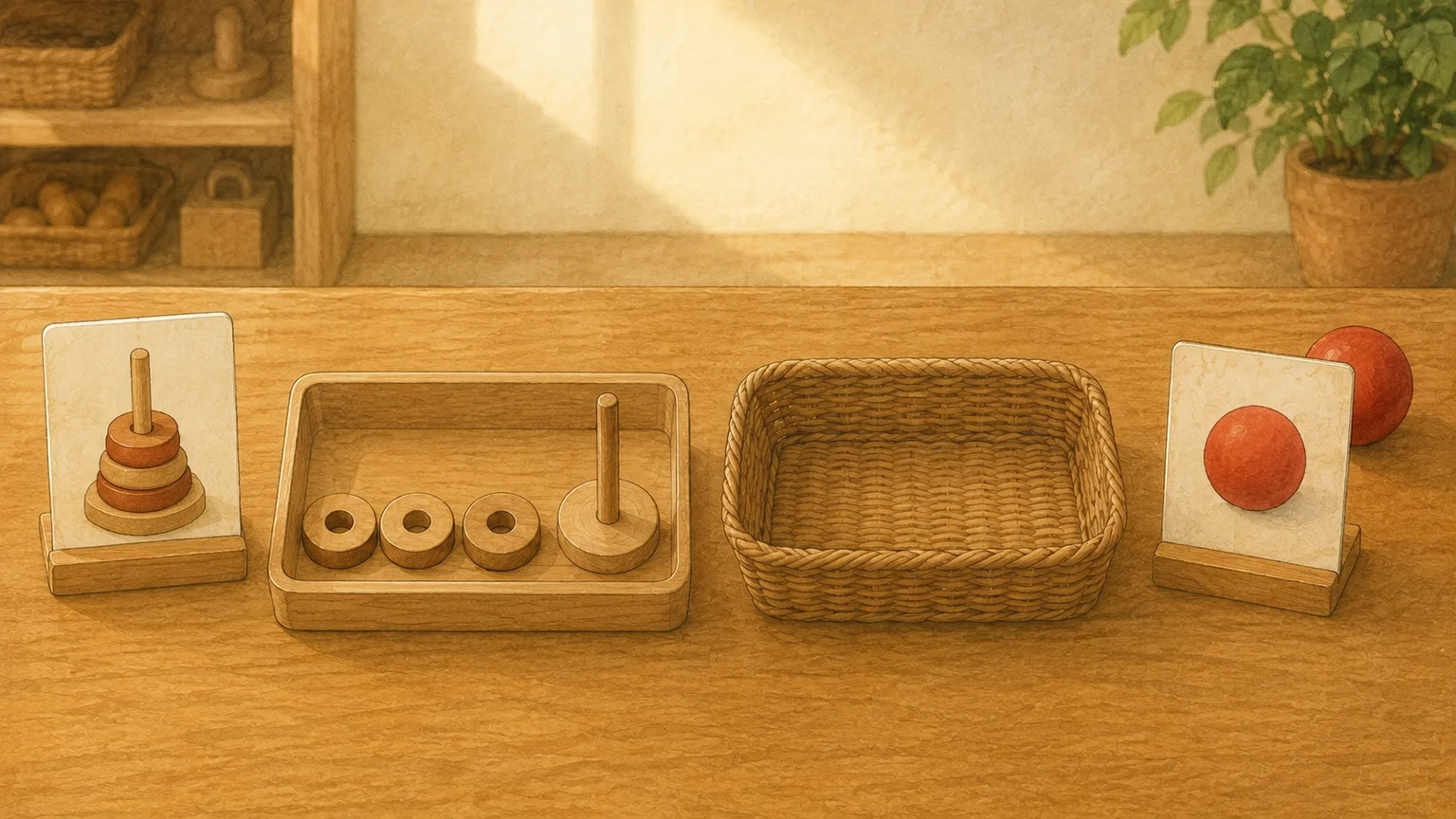
A work system. The part people forget, and arguably the most distinctive. It answers four questions at the child’s own station: what work, how much, how do I know I am finished, and what comes after. Concretely: baskets on one side, done tray on the other, a card that says what comes next. When those four answers are visible, an adult does not have to stand there.
Figure — The four work-system questions
- What do I do?
- How much is there?
- How do I know I am finished?
- What comes next?
Visual structure of the task. The material itself shows what to do — a tray with four slots for four items, colors that pair, a jig that only fits one way. If the task’s own layout answers the question, no instruction is needed.
Where it sits next to teaching by trials
This is where most comparisons go wrong, because the two things are usually presented as competing schools.
Teaching by discrete trials arranges a learning opportunity: a clear request, help that fades, a consequence, and a record of what happened — repeated enough times, and varied enough, that a specific skill gets established. Structured teaching arranges the setting in which a child works, so that they can do what they already know how to do without an adult narrating it.
Those are different jobs. A child can be taught to match pictures through carefully arranged trials and then use that skill inside a work system that no longer requires anyone to hover. In practice most good programs borrow from both, and the argument about which is “the” method mostly happens in writing.
The two are not opposed on WHAT can be measured — either framework can track independence, and either can track acquisition of a named skill — but they typically lean on different evidence in practice: structured teaching’s own literature leans on adaptive and daily-living outcomes, while trial-by-trial teaching leans on acquisition of a specific target, measured directly. Ask which question you are trying to answer before deciding which emphasis you are short of.
Two limits worth stating
A work system does not by itself teach a skill the child does not have. It makes an existing ability usable without help; building a genuinely new one — telling two pictures apart, for instance — needs its own direct instruction, whether that instruction comes from TEACCH’s own teaching strategies or from another approach.
And structure can be built for the adult’s comfort rather than the child’s independence. The test is simple and slightly uncomfortable: over weeks, is the adult doing less? If the schedule, the station and the labels keep growing while the prompting stays the same, the structure has become decoration.
Further reading
- Matching activities for children with autism — the skills a work system assumes are already there.
- ABA therapy activities — what to do in the ten minutes of direct teaching around all this.