
The costly part of a plateau is the time a useful signal sits in a dashboard before somebody decides what to do. The extra trials are only half of it.
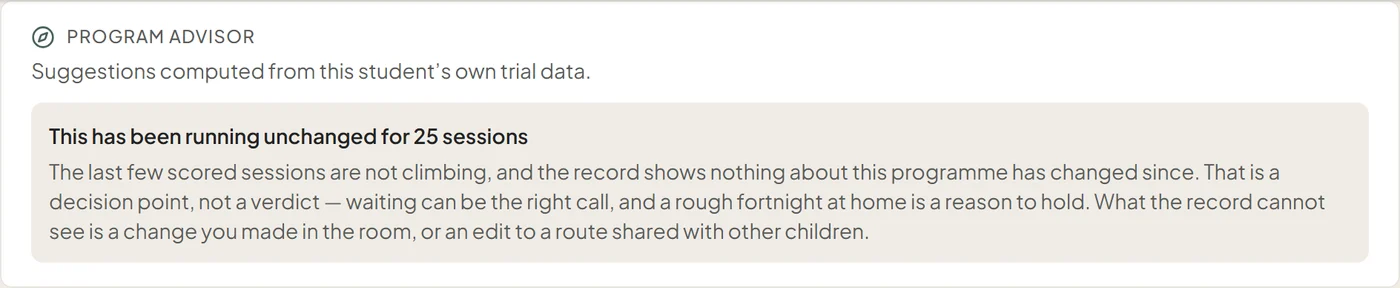
Interlaza’s decision support is designed around that gap. It organizes evidence, checks whether the evidence is interpretable and presents a change for an Instructor to accept, reject or adapt.
- Read the signal
- Check the data and context
- Decide and record the review
First gate: did the procedure actually run?
Suppose a target is taking more trials than expected. If prompts, correction, reinforcement or probe rules — a few trials run with no help and no feedback, checking whether a relation or skill holds up beyond what was directly trained (not always on brand-new material; sometimes the material is familiar and only the question being asked of it is new) — were not delivered as designed, changing the target sequence may solve the wrong problem.
Procedural fidelity is therefore a gate on WHICH recommendations get shown, not another decorative percentage, and it does not gate on missing evidence. With fewer than 20 checks recorded, no fidelity percentage available, or an error reading the record, the gate stays open and the advisor still surfaces its usual recommendations — closing the gate needs enough evidence, and that evidence showing too many deviations. Only then does it withhold the recommendations that would restructure the program (a new prerequisite, more errorless support, moving off the tablet), replacing them with a prompt to check fidelity first.
Four signals with different jobs
- Learning trend: is the evidence that actually counts — teaching sessions, not probes or reviews — rising, flat or falling across comparable work?
- Trials to criterion: how much instruction did this target require compared with the learner’s own relevant history?
- Fidelity: was the procedure delivered closely enough to interpret the result?
- Decision latency: once a review signal appeared, how long did it remain unresolved?
None of these numbers should decide alone. Together they tell an Instructor whether the likely work lies in the target, the prerequisite, the prompt plan, the session conditions or the implementation itself.
What a useful recommendation looks like
“Progress is poor” is not a recommendation. A useful card names:
- the signal that triggered review;
- the evidence window behind it;
- any fidelity limitation;
- one concrete proposed change;
- the scope of that change;
- the option to decline it.
Possible changes include reviewing a prerequisite, adjusting support, using new examples or moving temporarily to real-object practice. The app can make those options easier to reach. The Instructor still determines which one is clinically coherent.
Here is what that looks like put together, for an illustrative learner we’ll call Marta. Her mastery estimate on an early, level-1 target has barely moved over her most recent trials — the signal. The window behind it is that same recent stretch of teaching trials. Fidelity is adequate: prompts and reinforcement were delivered on the recorded pattern, with no deviation flagged. Given a flat estimate at this early level and adequate fidelity, the card proposes one change — raise the errorless support on this target — scoped to Marta alone, with a one-tap option to decline it and record why. Change any one of those four pieces and the right response changes with it: if fidelity had instead come back incomplete, the card would ask to check implementation before touching the target at all.
Scope matters
If several students use a shared route, evidence from one student should not rewrite the route for everyone. Interlaza keeps the affected learner and pathway visible before applying a change.
That small product detail protects a large clinical distinction: an individual adaptation is not a new universal program rule.
Silence can be a feature
A screen full of warnings turns review into alarm management. If evidence is progressing, fidelity is adequate and no decision is overdue, there may be nothing pertinent to show.
Interlaza aims to surface exceptions that deserve attention rather than reward the user for clearing notifications.
Why this is useful
Automation is often sold as “the system decides for you.” In professional learning support, that is the wrong promise.
What Interlaza offers instead is narrower and more useful: the evidence behind a decision is assembled before the review, the limits are visible, and the action does not disappear into somebody’s memory.