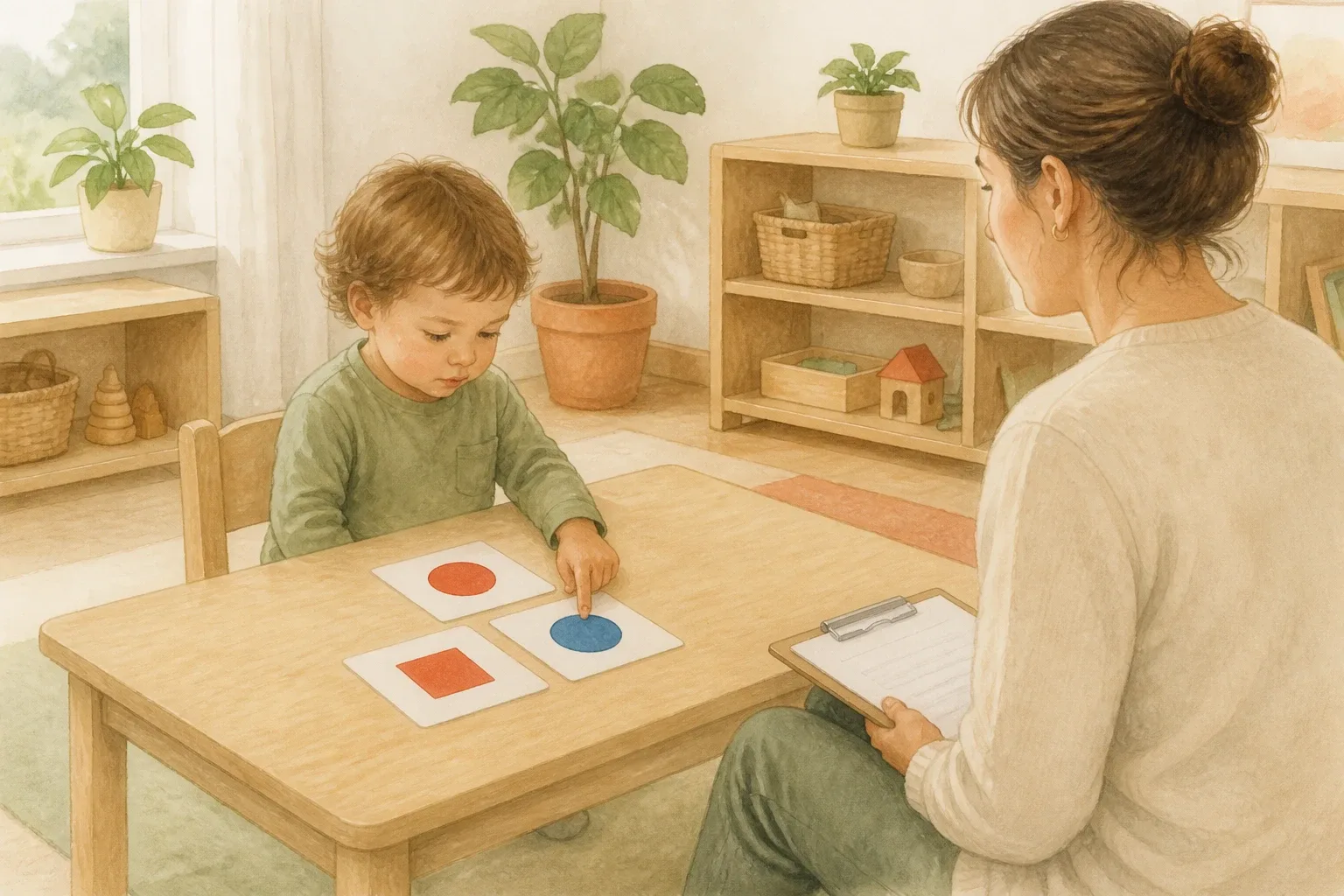
A child of two and a half, sitting at a table. In front of them, a card with a red circle. Below it, two cards to choose from: a red square and a blue circle. The instructor says: “pick the same one.”
The child picks up the blue circle.
Were they right?
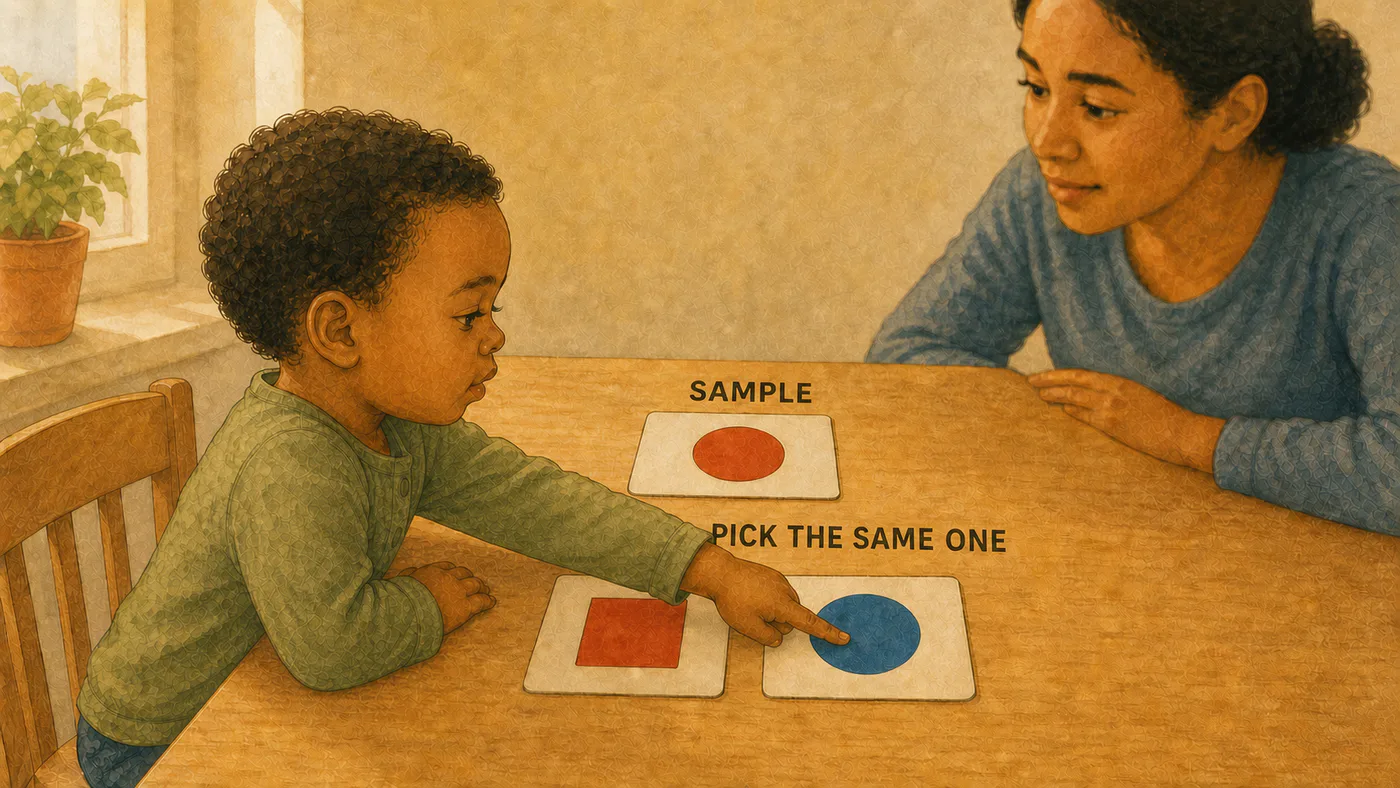
Figure 1. The table: sample on top, two options below, the child’s finger on the blue circle.
Everything that follows comes out of that question. Two Mexican researchers answered it from different angles: Julio Varela asked what survives when I change the situation; Emilio Ribes asked what kind of contact this child is having with what is on the table. Interlaza uses both answers. This first part tells Varela’s; the second tells Ribes’ and where the two meet.
1. There is no bare “the same”
Look at the cards again. The red square is the same as the sample in color. The blue circle is the same as the sample in shape. The instruction “pick the same one” has no answer until somebody decides what to look at.
That somebody is us. The child did something perfectly coherent: they matched by shape. It is only an “error” if the instructor had color in mind. Nothing about the cards says that matching by shape is wrong.
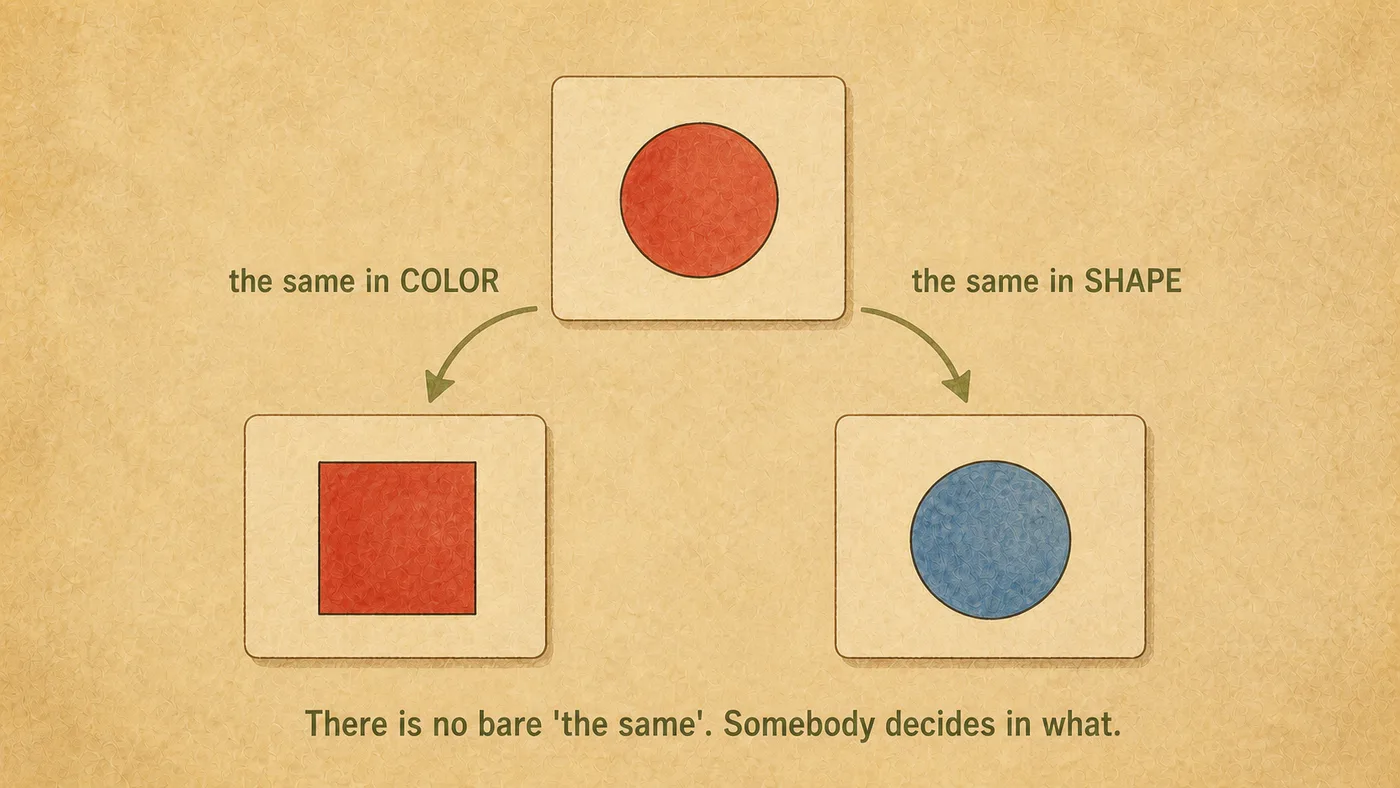
Figure 2. The same sample, two “correct” answers depending on the criterion: an arrow from the red circle to the red square labeled “color”, another to the blue circle labeled “shape”.
That has two practical consequences, and both are in the app:
- Some errors are compatible with a different criterion, and it is worth checking rather than assuming. Saying “wrong” throws that possibility away. Saying “matched by shape” keeps it open — though a choice can also come from a position preference, an unintended prompt, how the material was arranged, or plain variability, so “matched by shape” is itself something to verify, not a verdict.
- A trial in which the correct answer matches the sample in every way does not reveal which dimension is doing the work. If the right option is an identical red circle, the child can be right by looking at the color, at the shape or at both, and the trial alone cannot say which — though it does confirm the child can select correctly under that arrangement, which is not nothing. What it cannot do is tell the criteria apart, which is why a further check that isolates one property is still needed.
The technical name, if you need it: the criterion is what decides what counts as a match. Ribes puts it in a way worth keeping: relational properties “do not reside in the objects”; they are set by whoever arranges the situation. In Interlaza, the instructor holds the criterion, and the app records it.
2. Varela’s question: what survives when I change something?
Suppose the child already matches red circles to red circles without fail. Have they learned “the same in shape”, or have they learned those cards?
Varela proposes to answer by changing something and watching whether the correct answers hold. To be able to say what was changed, he describes any matching situation with four pieces:
| Piece | What it is | On the table |
|---|---|---|
| Instance | The concrete object in use | This red circle, and not another |
| Modality | The property the match is made on | Color, shape, size |
| Relation | The rule | ”The same”, “the similar”, “the different” |
| Dimension | The domain the judgment is made in | Geometric shapes, words, quantities |
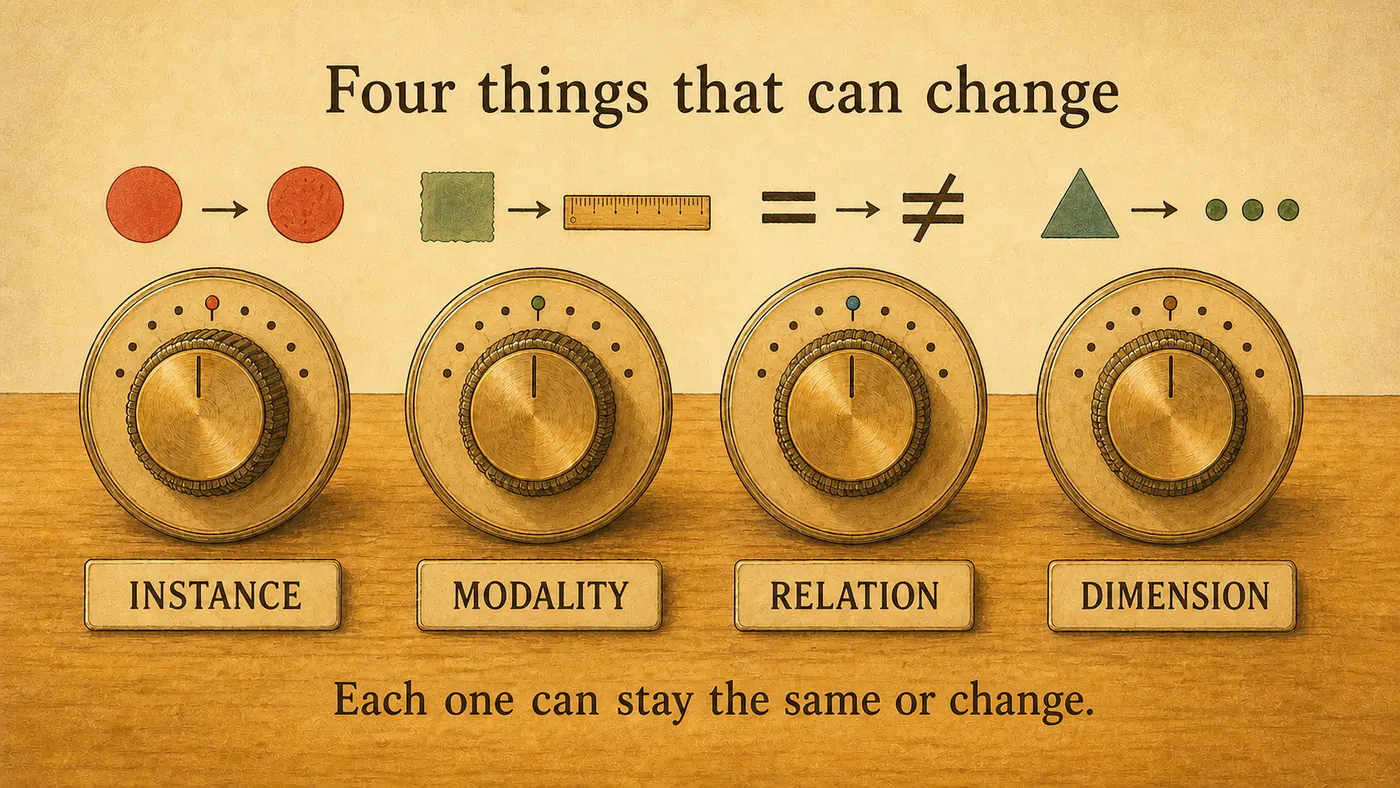
Figure 3. Four dials on the table, each with its label and an example: Instance (another red circle), Modality (color → size), Relation (same → different), Dimension (shapes → quantities).
Each piece can stay as it was (constant) or change (variable). If a single piece changes and the child is still right, we know their correct answers did not depend on it. Everyday examples:
- Change the instance: show them a different dog from the one they practised with. Do they still pick “dog”?
- Change the modality: the match was by color, now it is by size. Do they understand that a different property is now in charge?
- Change the relation: they had to find “the same”, now “the different”. The cards are identical; the correct answer changes.
- Change the dimension: they had to match shapes, now quantities. Three circles are no longer “a circle”: they are “three”.
With four pieces that can each change or not, you get fifteen combinations (all of them except “nothing changes”, which is not transfer). Varela gathered them into a table he called the Competence Transfer Matrix (1995). And he gave what that table measures a name Ribes uses too: functional detachment — how far the child’s response has come loose from the concrete properties that were in front of them when they learned.
The table is a map, not a ladder
Here is the most frequent mistake, and we made it ourselves for months. The table has fifteen numbered rows, and the numbers invite you to read it as a ladder of difficulty: row 1 easy, row 15 impossible.
It is not so, and Varela said so himself. In 2001 he tested five of the fifteen combinations with children aged 9 to 11 and students aged 16 to 20. The children did better when two pieces changed at once (instance and modality) than when a single one changed (the dimension). And the two hardest combinations, for both ages, were changing the relation and changing the dimension, regardless of how many pieces moved. His conclusion, in his own text: call the rows types of transfer, not levels, and “reconsider the hierarchical order”.
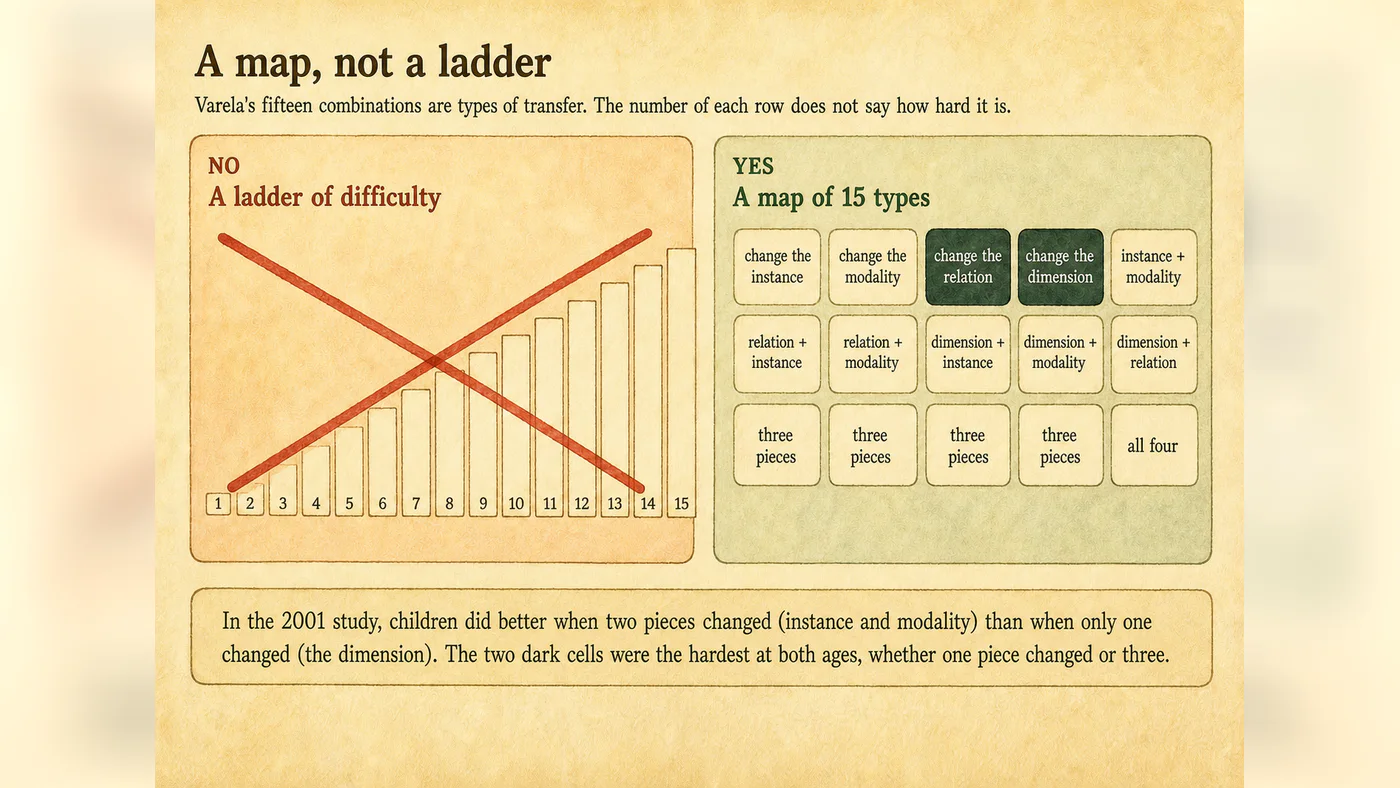
Figure 4. On the left, crossed out, a ladder of 15 steps. On the right, the alternative: a map of 15 cells of the same size, with no route arrow, two cells shaded (“change the relation”, “change the dimension”) and the legend “the hardest in 2001, with one piece or with three”.
The map itself is not a closed case, either: Varela’s own factors do not cleanly separate every one of the fifteen cells, and some combinations are hard to tell apart with his own data. Reading it as a map rather than a ladder corrects one mistake; it does not certify that all fifteen rows are equally well established.
The consequence for Interlaza: the app never says “level 4 is harder than level 1”, and never walks the table in order. Interlaza’s probes work the same way — a handful of trials in which one piece changes, without telling the child whether they were right — and they cover the two combinations Varela’s research points to as most accessible, though not from the same door. Any mastery-gated stage can reserve untrained exemplars and probe with them (changing the instance); the alternating-criterion activity, described in the second part, is what adds a probe for which property decides the answer (changing the modality) — and only where the stage’s pool actually supports it. Where either runs, the reading is clear, and the child has not been asked a harder question than they were actually taught to answer.
3. The pair at the top
There is a detail of Varela’s procedure that looks small and is not. In his trials, before the sample, a pair of stimuli appears at the top. That pair is not decoration: it shows the rule of the trial with other examples.
If the pair at the top is two dots and two dots, the rule is “the same quantity”. If it is three dots and two dots, the rule is “a similar quantity”. The sample and the options below can be identical in the two trials; what changes the correct answer is what the pair at the top exemplifies.
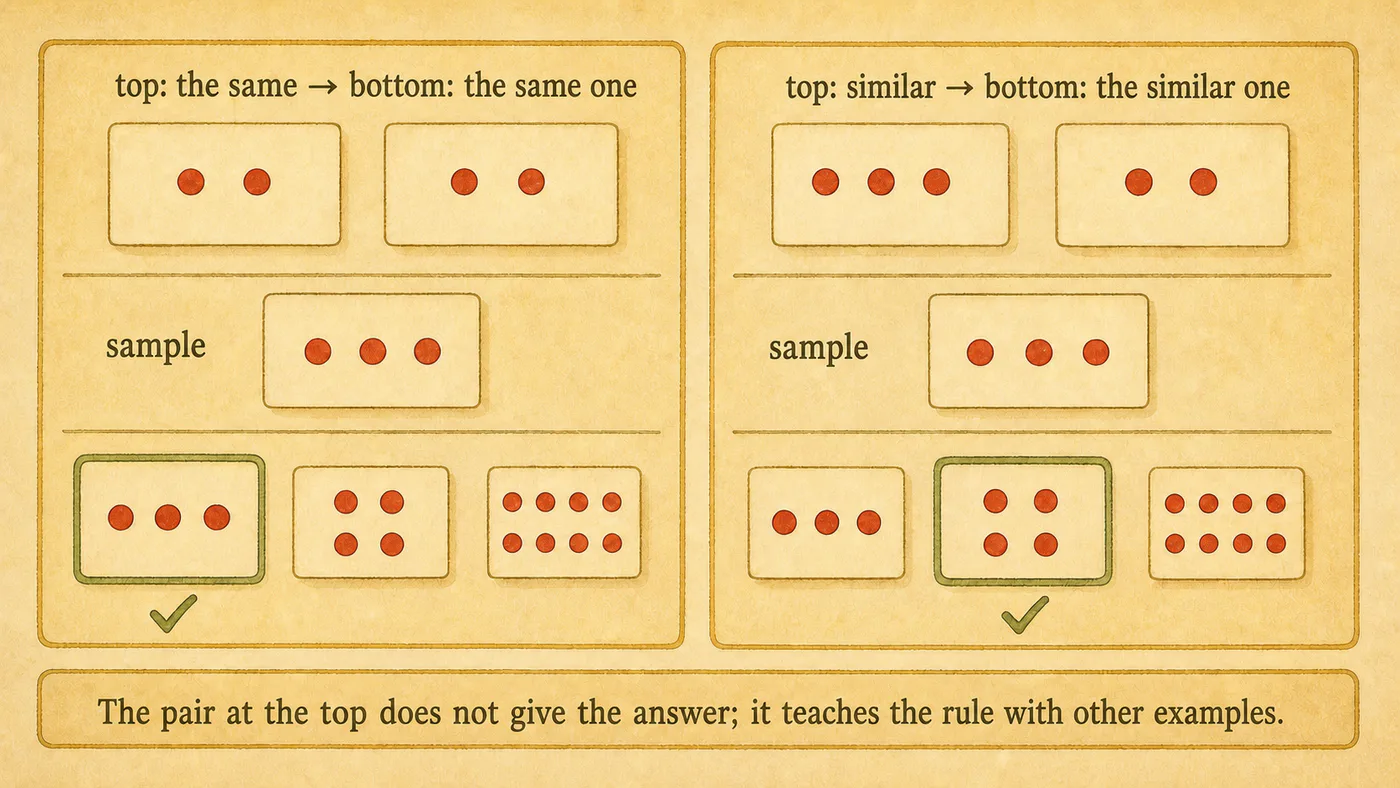
Figure 5. Two trials side by side with the same sample (3 dots) and the same options (3, 4 and 8 dots). In the first the pair at the top is “2 and 2” and the marked answer is 3. In the second the pair is “3 and 2” and the marked answer is 4. Below, the line: “The pair at the top does not give the answer; it teaches the rule with other examples.”
Varela calls that pair “the exemplar” and the sample with its options “the example”, and in 2006 he wrote the sentence that settles any doubt: “the correct response depends on the second-order stimuli presented in each trial”. The child has to extract the relation from the top and carry it down; that carrying is the task.
We tell this because in Interlaza we did it backwards for a month: we built the pair so that it “would not reveal the relation”, thinking that if it showed it the child would copy. It was the exact opposite of the published procedure, and every result from that version is marked as invalid. The rule is fixed now: the pair exemplifies the relation, and the app uses it that way in the alternating-criterion activity, which the second part describes.
What is left for the second part
So far, Varela’s question: what survives when I change something. Still to come is Ribes’ — what kind of contact the child is having with the cards — the warning that being right does not say which contact you are in, and the 2009 study in which Ribes used Varela’s tests as the answer to his own question. All of it is in the second part, together with the four concrete decisions Interlaza makes with the two questions.
Glossary in three steps
Each term, in the order the article itself asks for: example → explanation → name.
- A different dog from the one they practised with → the concrete object → instance.
- Color was in charge, now size is → the property the match is made on → modality.
- Before “the same”, now “the different” → the rule → relation.
- Before shapes, now quantities → the domain the judgment is made in → dimension.
- Being right with cards they never saw → coming loose from the concrete → functional detachment.
- A pair at the top that teaches the rule with other examples → second-order stimuli.
- Being right after something changed, with nobody saying whether they were → transfer probe.
Sources: Varela, J. & Quintana, C. (1995). Comportamiento inteligente y su transferencia. Revista Mexicana de Análisis de la Conducta, 21(1), 47-66. — Varela, J., Padilla, M. A., Cabrera, F., Mayoral, A., Fuentes, T. & Linares, G. (2001). Cinco tipos de transferencia. Revista Mexicana de Análisis de la Conducta, 27(3), 363-383. — Varela, J., Martínez-Munguía, C., Padilla, M. A., Ríos, A., Avalos, M. L. & Jiménez, B. (2006). Primacía visual: transferencia ante el cambio de la relación entre estímulos. Revista Latinoamericana de Psicología, 38(1), 119-135. — Ribes-Iñesta, E. (2018). El estudio científico de la conducta individual. Manual Moderno, ch. 10. Full references are on our science page.