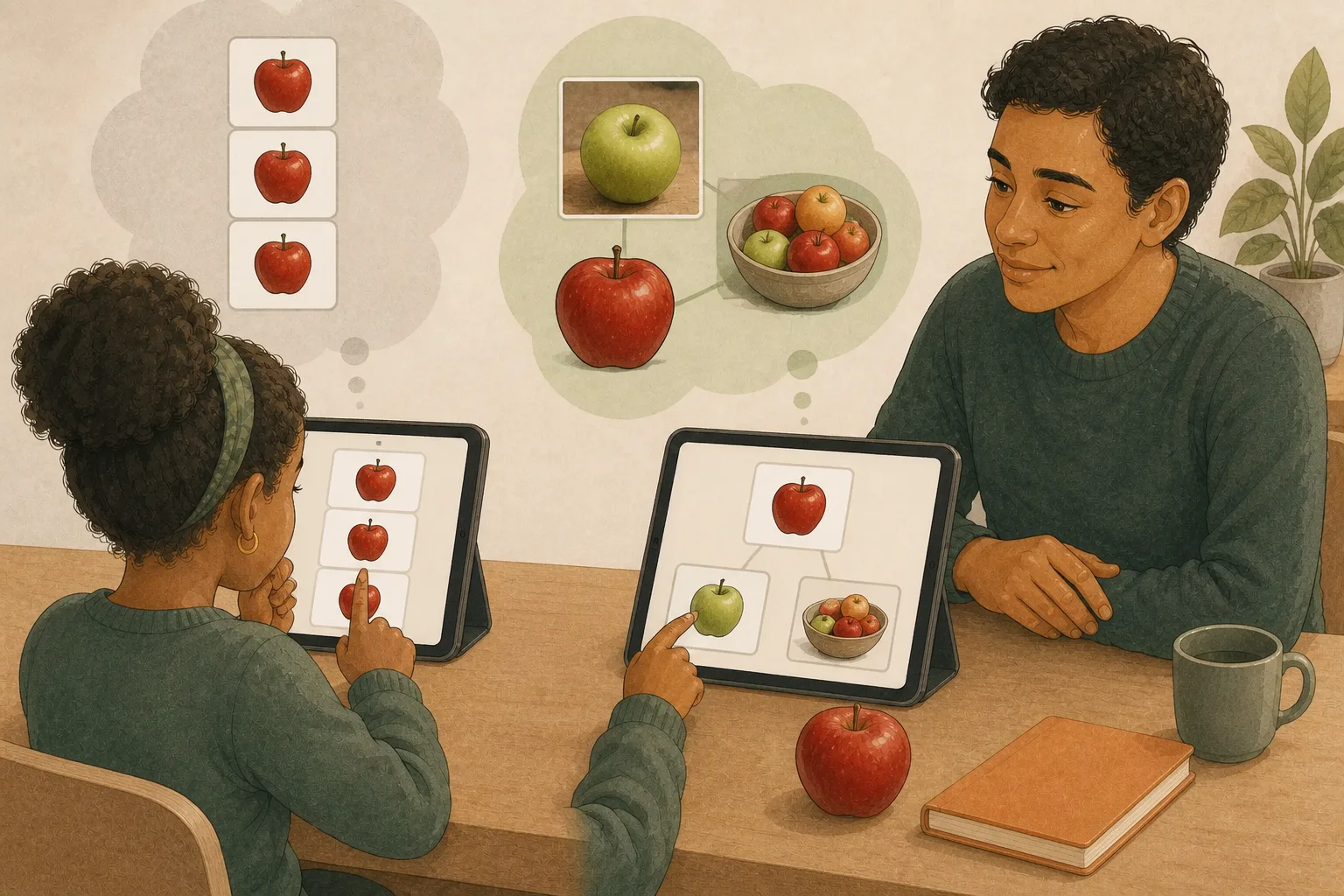
There is a strawberry on the table. Below it, two options: another strawberry and a banana. The child touches the strawberry. Correct. Twenty trials later accuracy sits around 95% and the stage is marked as mastered.
What has been learned?
Two ways to be right about the same card
Picture the session of two different children.
The first looks at the card on top, compares it with the two below, and touches the one that matches. Put a tomato on top tomorrow and they will touch the tomato.
The second has learned that touching the strawberry makes a pleasant sound happen. They do not need to look up. They have memorised a gesture, and the gesture works because the strawberry is always the right answer.
Both finish the week at the same 95% correct. On screen they did exactly the same thing. And the difference matters, because the first child will carry what they learned to a new card and the second will not.
Which yields a question any instructor can ask of any task:
Could the child be right without looking at the card on top? If the answer is yes, however well they perform, what the task has demonstrated is memorising rather than comparing — that memorised gesture is still a real conditional discrimination, it just isn’t the relational one the score is being read as.
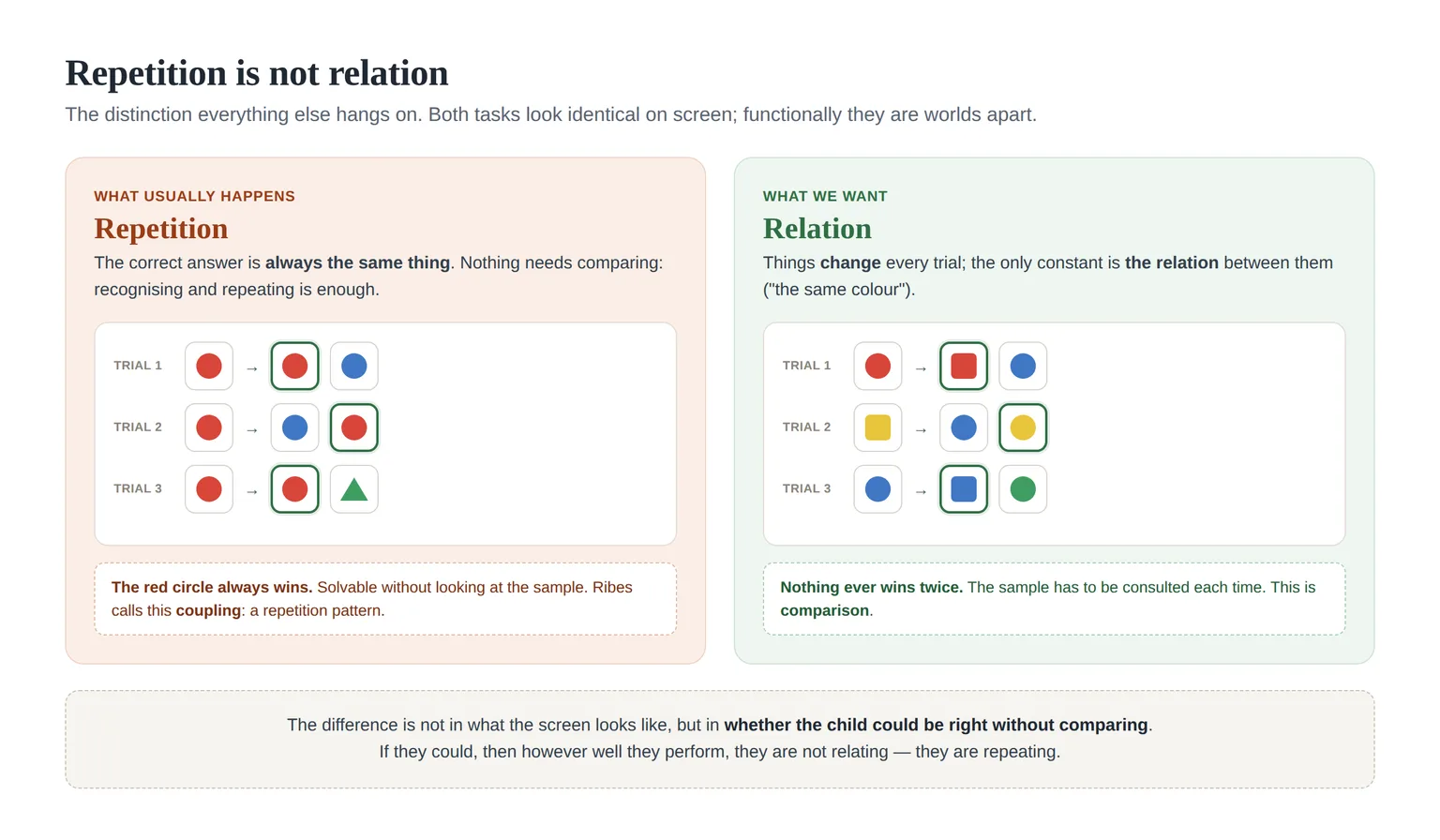
The distinction is the Mexican psychologist Emilio Ribes’, who calls the two coupling (recognizing and repeating) and comparison (responding to the relation between things). It is set out in full, with two children who score the same while doing different things, in “95% of what?”. In Ribes’ account (Ribes & López, 1985), recognizing the same object again and again is not, by itself, comparative or relational behavior — it is a repetition pattern, and identity or a fixed arbitrary pairing can establish a real conditional discrimination without the child ever comparing anything.
One thing here usually surprises people: matching two identical photographs is not an easier version of comparing, it is a different thing. Neither are fixed pairings: if “when red appears, touch yellow” never varies, the child can learn that pairing — a genuine, useful skill — without it requiring or demonstrating any grasp of a relation.
Recognizing and repeating are useful too
None of this makes those tasks worthless. They get a child ready to compare later: someone who cannot yet tell two cards apart cannot compare them. Ribes makes the same point — coupling contacts do not disappear once comparison appears; they stay in place as the constant background against which relational contingencies can emerge (Ribes & López, 1985).
What matters is knowing which of the two a task is practising at any moment, and not reading a high score on the first as if it came from the second.
Four design decisions
INTERLAZA does not leave this to chance. Four concrete decisions, all of them visible in how trials are generated.
1. Every object takes all three parts
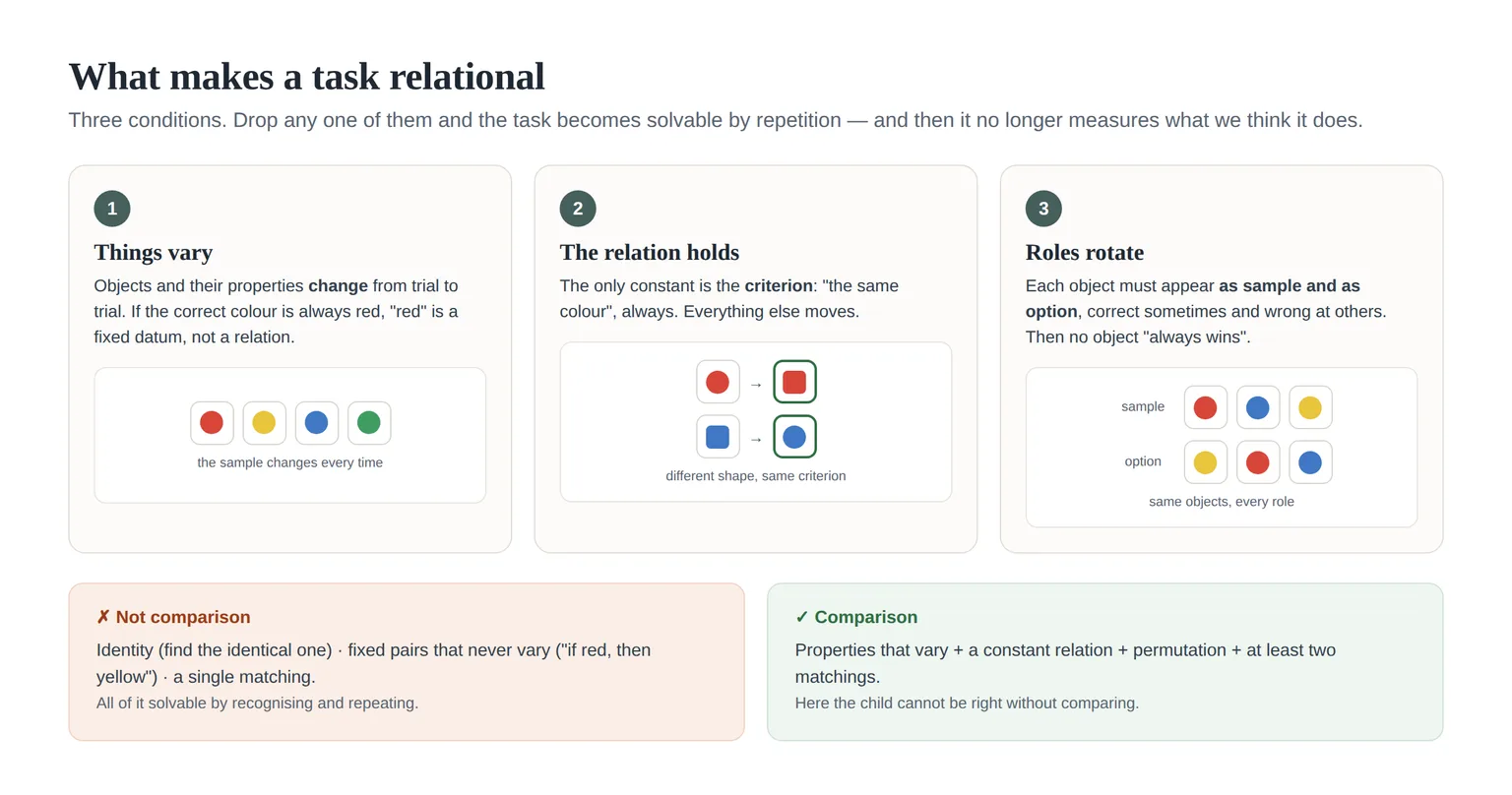
Every object appears sometimes as the card on top, sometimes as the right answer and sometimes as a wrong option. That way the child cannot be right by touching the same picture every time. The generator does not choose at random: it favors whichever has appeared least.
This sounds like a detail. It is not. Shuffling positions is not enough. Varying whether the answer sits left or right prevents a side bias, and does nothing about an object bias. Pure randomness distributes well in the long run, but a stage is a few dozen trials, and across that stretch it can leave one object sitting in the same post from beginning to end.
2. Colors and sizes get spread out
When a stage is prepared, the objects are spread across several colors, several sizes or several shapes, depending on what is being worked on. If eight of ten foods were red, “red” would stop being one property among others and become a fixed fact: touching whatever is red would score well above chance on its own — no comparing required, and no way to tell that shortcut apart from a genuine one by the number alone.
3. The only thing that repeats is the criterion
Objects and their properties change from trial to trial. The only thing held constant is the instruction: “the same color”, “the same size”. With everything else moving, being right is only possible by looking and comparing.
4. Teaching that trains a relation is checked
And here is the decision that sets us apart.
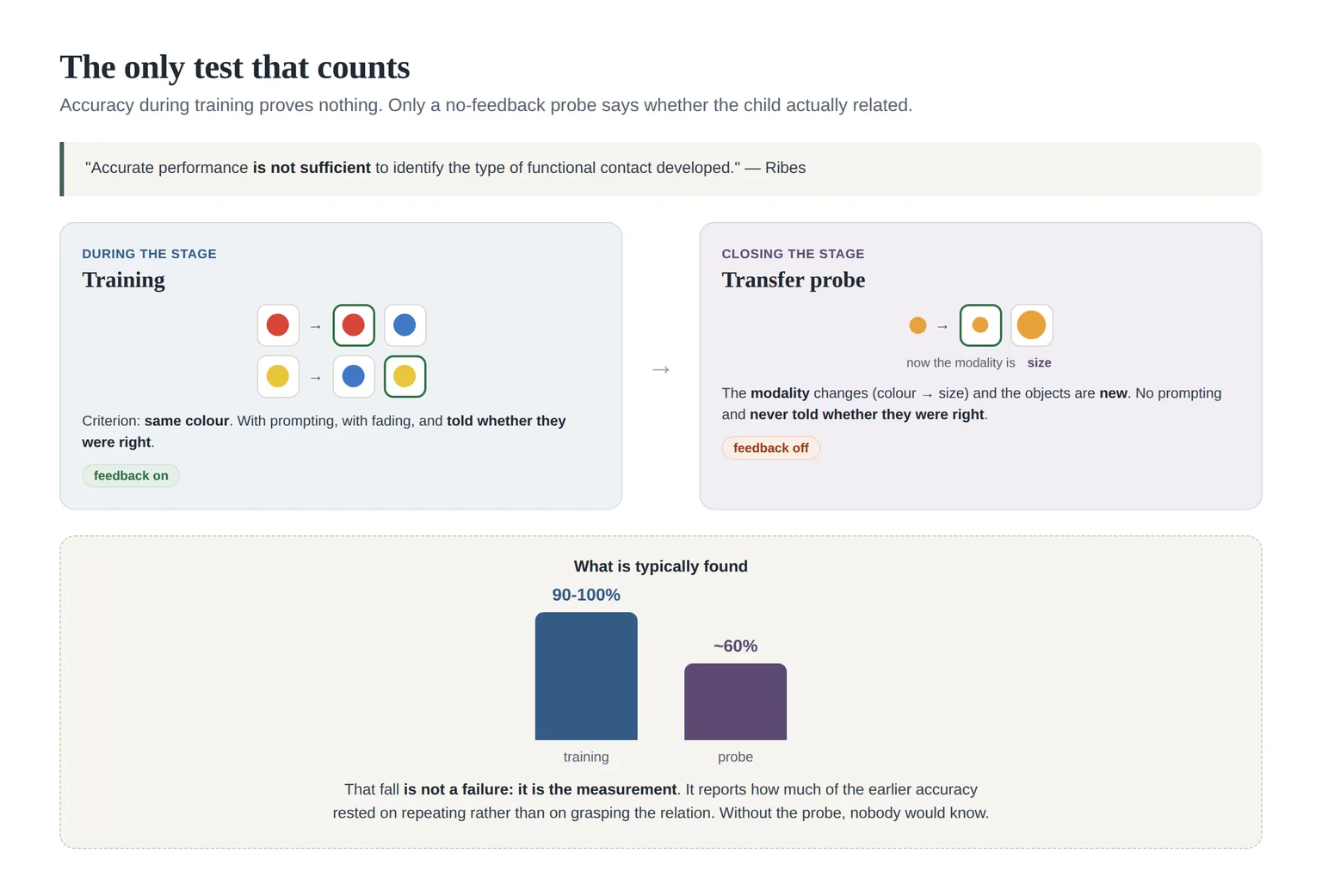
If being right during training does not show what the child learned — and it does not — something else is needed. Ribes puts it plainly: accurate performance during training is not, on its own, enough to tell you what kind of contact the child actually developed (Ribes & López, 1985).
Ribes treats the checking trial as the key indicator available: a few trials run under two conditions that are uncomfortable and informative for exactly that reason. The professional word for them is probes, and that is what they are: a handful of trials on material the child has not practised, with no help and no telling them whether they were right. Where our routes have this in place, it is appended once per teaching block, not repeated after every single stage inside it — see the “95% of what?” article for how that evidence is read.
What they have to look at changes. If the child trained on “the same color”, they are now asked for “the same size”, with objects they have not seen. A child who grasped “the same in some respect” carries it across. One who memorised colors does not.
And they are not told whether they were right. No confirmation, no sound, no green. The moment feedback appears we stop measuring and go back to training.
In the early stages — two identical photographs, word→picture, sound→picture — the check works differently, because no property is trained there. What changes is the picture: the answer is shown in its other version, photograph to drawing. A child who learned the dog keeps being right when the drawing changes; one who learned that particular photograph does not.
No check scores, and none gates progression. It is an instrument, not an exam.
What to expect from that check
Better to say it before it happens: the score can drop. By how much, if at all, is not knowable in advance; it depends on the child, on what was trained and on how much the material changes. We have no number of our own to offer here, and an invented one would be exactly the kind of figure this article asks you to distrust.
A drop on new material tells you some of the earlier accuracy rested on what the child had already practised — but a drop can have more than one cause, including novelty, fatigue or an unrelated bad moment, and it is not the only informative outcome: a child who holds their accuracy on genuinely new material is showing you something too. Without the check, 95% would read as understanding either way, and nobody would know which.
Where the method comes from
The idea is not ours. It comes from Julio Varela and Carmen Quintana, whose Competence Transfer Matrix (1995) does exactly this: it separates any learning situation into four things that can change or stay fixed, and looks at what happens when one moves and the rest hold. Fifteen distinct types of transfer fall out of that.
Both of our checks are cases of theirs. Changing only the picture, holding the instruction, is their case 1, what we use going from photograph to drawing. Changing what has to be looked at — color to size, holding the picture fixed — is their case 2; keeping case 2 from also moving case 1 at the same time (a new picture and a new question at once) is the discipline the design is meant to hold, since a probe that moved both would no longer tell the two apart.
It is also worth not confusing this with generalization. Varela notes that behavioral writing routinely treats the two as synonyms, and that this blurs them. Classical generalization moves one thing: a response spreads to new stimuli because they resemble the trained ones. Transfer requires both to move, the stimulus and the response (Ribes, 1990).
Sidman’s equivalence tests belong to the same family of reasoning: what matters is not what the learner does with what was trained, but what they do with what was never trained.
What changes when you read a session
There is a practical consequence that goes beyond software and applies as much at the table as on a screen.
When a child gets something wrong, the usual reading is “they don’t have it”. But very often what they have done is respond to something other than what we had in mind: position, the most salient object, a partial feature. From their point of view nothing failed: they were consistent with another criterion.
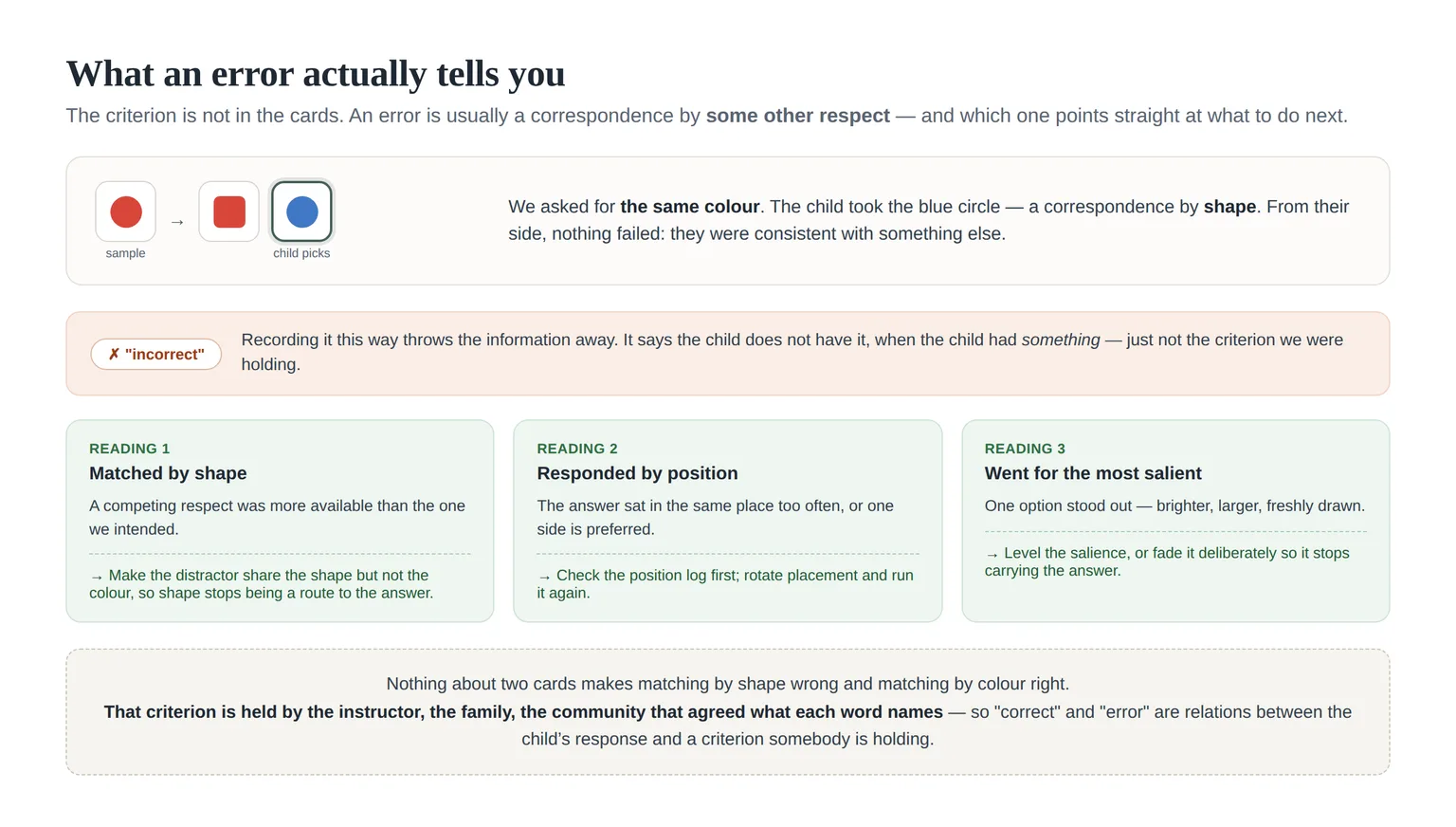
Recording “incorrect” throws that away. Recording “responded by position”, or “matched by shape when we asked for color”, keeps it, and points at what to do next — though a single error is only a hypothesis; it takes a pattern across several trials before you can say the child is actually running on that other criterion rather than having simply missed one.
Because the criterion is not in the cards. Nothing about two cards makes matching by shape wrong and matching by color right. That criterion is held by the instructor, the family, the community that agreed what each word names. “Correct” and “error” describe the relation between what the child does and a criterion somebody is holding.
Designing a teaching platform is, in large part, deciding how carefully that criterion gets held.
INTERLAZA draws on the interbehavioral tradition (Kantor; Ribes and López), Varela and Quintana’s Competence Transfer Matrix (1995), Sidman’s stimulus equivalence, and Relational Frame Theory. Full references are on our science page.