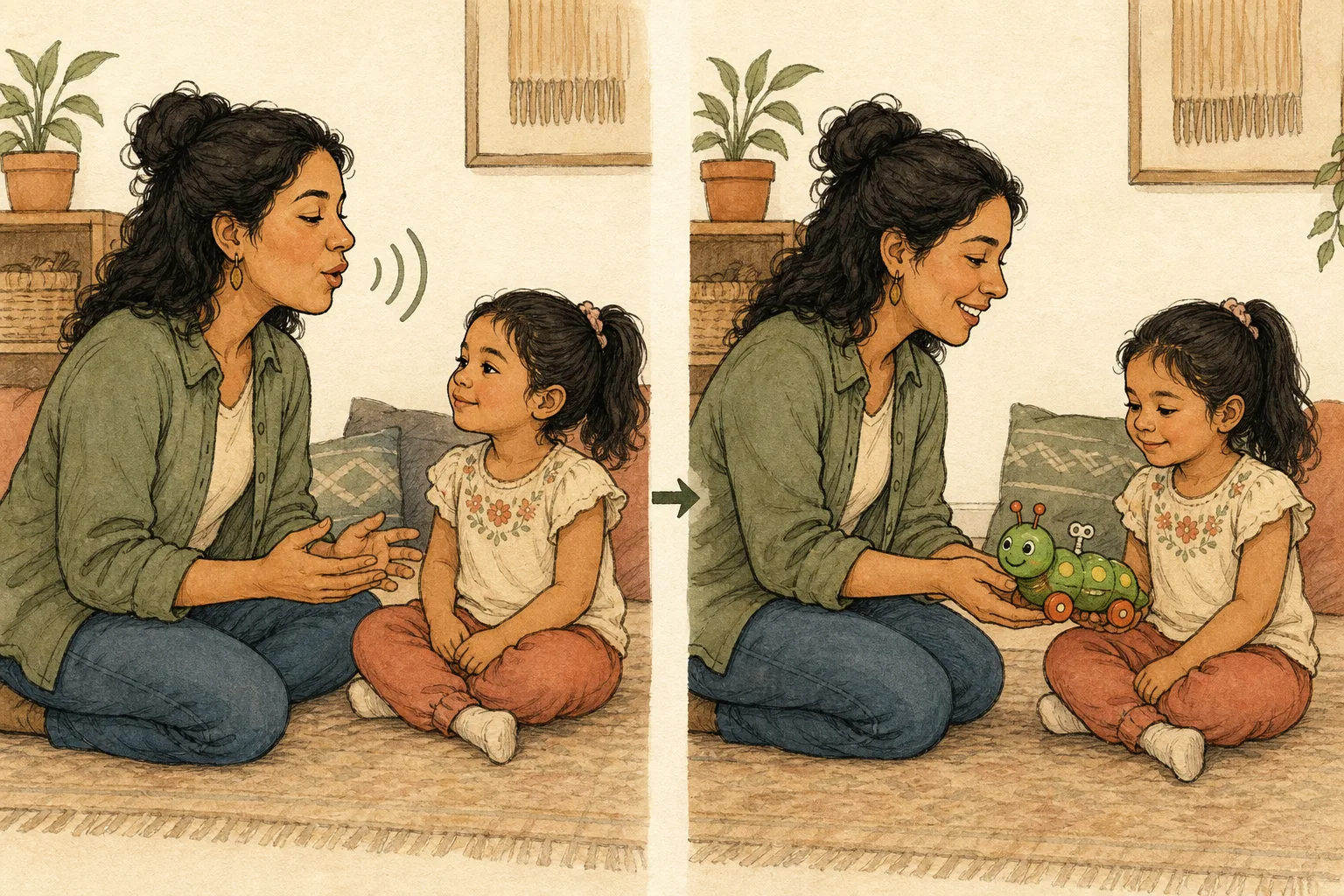
Most teaching software begins by asking the learner to do something. Touch, match, say, choose.
Forward stimulus–stimulus pairing is different. The adult arranges two events in time and asks the child for nothing.
Figure — Forward pairing: the order is the procedure
-
Adult says a sound the child already produces
-
Brief planned interval
-
Adult delivers a preferred item — whatever the child does
No instruction to respond · no prompt · no correct/incorrect score
Why the order is fixed
Freitas, Henry, Kelley and Tonneau compared forward pairing, backward pairing and a control condition with a small group of young autistic children. Forward pairing produced more target responses than the other conditions, while overall target responding remained low (Behavioural Processes, 2020).
The study’s mean counts per session were about 0.70 for forward, 0.20 for backward and 0.19 for control. That is an important combination: the order mattered, and the effect was not a flood of new vocal behavior.
Interlaza therefore implements forward order only. Offering a direction setting would make it easy to run the procedure the study found less effective.
The adult selects the sound
The target is a sound or recombination the child already emits spontaneously, identified by listening during free play or observation, and not a word the adult hopes they will learn.
That is not the same as picking a vocalization the child already produces as a whole unit — the target may be a combination the child has never said together, built entirely from sounds already in their own repertoire. “Ba” counts if the child already says “bo” and “ca” separately, even though “ba” itself is new.
Interlaza ships no default sounds because a generic list cannot make that judgment. The Instructor records the selected sounds and the preferred item after observing the individual learner.
No response contingency
The preferred item follows the sound whether the child looks, vocalizes, reaches or does nothing. If the adult waits for an approximation before delivering it, the activity has changed.
That is why the runner keeps the core instruction visible throughout the session. ABA-trained adults are used to making reinforcement contingent on a response; this procedure requires the opposite arrangement.
What the record can say
Interlaza can record completed pairings and any target responses observed. It does not report accuracy because there was no correct opportunity. It does not apply prompts, mastery criteria or Bayesian Knowledge Tracing because none belongs to the procedure.
A session with zero target responses is not automatically failed. The cited study averaged less than one forward target response per session. Counts across repeated, faithfully implemented sessions are the appropriate description.
Why it belongs in Interlaza
Learners with little functional language are poorly served by a platform in which every activity begins with a demand and every result ends in percent correct.
Pairing broadens the platform while preserving a strict boundary: a Pavlovian procedure remains Pavlovian. Interlaza supplies the workflow, the timing and the record — not a guarantee that pairing will produce speech.