
Stimulus equivalence explains how a learner comes to treat a sound, a picture and a printed word as interchangeable. It is a powerful account, and it covers a great deal of early language. But it describes one relation: sameness.
Language does far more than sameness. A learner has to handle bigger than, before, opposite of, is a kind of, mine versus yours. None of those are equivalence relations, which needs reflexivity, symmetry AND transitivity together. Bigger than fails the simplest of the three — swap the terms and the meaning does not survive: if A is bigger than B, B is emphatically not bigger than A. Opposite of is actually symmetric (if hot is the opposite of cold, cold is the opposite of hot), and it still is not equivalence, because it fails transitivity — the opposite of an opposite does not chain the way same as does.
Relational frame theory (RFT) is the account that extends the equivalence story to cover all of these. This article is the practical version: what the theory claims, which frames matter for teaching, how contextual cues control which relation is in play, and how to actually train and test a frame with a learner in front of you.
The core claim: relating is learned behavior
The central RFT proposal is that relating stimuli to one another is itself an operant — a generalized, learned behavior shaped by a history of reinforcement across many exemplars, not a fixed cognitive structure that matures on schedule.
Crucially, the relation can be arbitrarily applicable: it can be brought to bear on any stimuli, regardless of their physical properties, when the right contextual cue is present. A five-cent coin is physically larger than a ten-cent coin in several currencies, and yet a competent speaker will say the ten is more. Physical size lost; the socially trained relation won. That capacity — responding relationally on the basis of a cue rather than on the basis of the formal properties of the stimuli — is what RFT calls arbitrarily applicable relational responding, and it is treated as the basic unit of language and cognition.
Three defining properties
A pattern of responding qualifies as a relational frame when it shows all three of the following.
Mutual entailment. If a relation is specified in one direction, a relation in the other direction is entailed. Trained: A is bigger than B. Entailed: B is smaller than A. Note what happened — the entailed relation is transformed, not simply reversed as it is in symmetry. Equivalence is the special case where the two happen to coincide.
Combinatorial entailment. Two entailed relations combine into a third. A is bigger than B, B is bigger than C, therefore A is bigger than C, and C is smaller than A. The learner has never been given A and C together.
Transformation of stimulus functions. This is the property that makes the whole thing clinically consequential. If a stimulus acquires a function, the theory predicts the other stimuli in the network acquire related functions in line with the relation between them — a prediction, again, that has to be checked rather than assumed. Tell a learner that Coin B is worth more than Coin A, then establish Coin A as worth having, and RFT predicts Coin B tests as worth more having too, with no direct experience of Coin B at all. Functions are predicted to travel through the network, transformed by the relation.
That last property is not new territory for the wider equivalence literature — Dougher and colleagues (1994) showed conditioned aversive functions transferring through an equivalence class. What RFT adds is a formal account for transfer through relations equivalence’s own symmetric, transitive framework cannot handle: how a word can become frightening through an opposite relation rather than a same-as one, or how a rule can control behavior before any contact with the contingency it describes.
Figure — Relating stimuli and testing changes in function
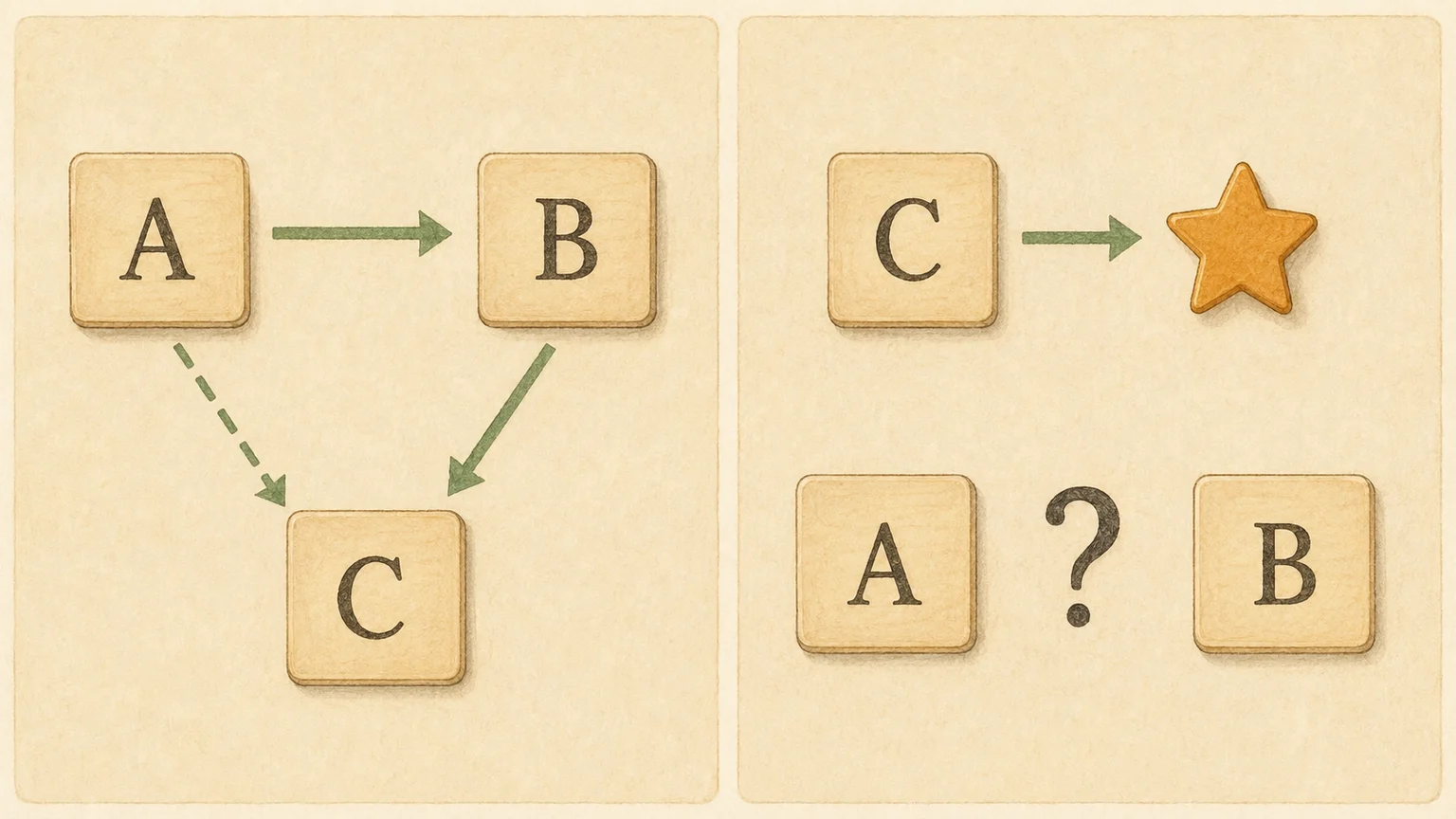
- A → B and B → C: trained relations
- A ⇢ C: relation to test
- Change of function: an additional question about responding to A or B
The frame families worth teaching
Frames are usually grouped into families. These are the ones that carry the most weight in early and intermediate teaching:
| Frame | Relation | Everyday form |
|---|---|---|
| Coordination | same as, goes with | This is a dog — the equivalence case |
| Distinction | different from | Which one is not a fruit? |
| Opposition | opposite of | Hot and cold, big and small |
| Comparison | more / less, bigger / smaller | Which glass has more? |
| Hierarchy | is a kind of, is part of | A dog is an animal; a wheel is part of a car |
| Deixis | I / you, here / there, now / then | Perspective-taking |
| Temporal / causal | before, after, because | Sequence and consequence |
Coordination and distinction usually come first and are the most straightforward to establish with matching procedures. Comparison and opposition are where many programs stop, and where a great deal of academic content sits. Hierarchy underwrites categorization, and deictic framing underwrites perspective-taking — both frequently targeted, both frequently trained in ways that never actually establish the frame.
Contextual cues: Crel and Cfunc
The practical heart of RFT is that relational responding is under contextual control. Two kinds of cue do this work, and keeping them distinct will change how you build teaching arrays.
Crel — the relational cue. It specifies which relation is in play. The words “bigger than”, “opposite of”, “goes with”, “is a kind of” are relational cues. So is a symbol, a color-coded card, or a hand sign. Change the Crel and the correct answer changes, with the same stimuli on the table.
Cfunc — the functional cue. It specifies which acquired function is transformed by the relation — a dimension like size or temperature is the easiest example, but the function in play does not have to be a physical dimension at all; it can be any property a stimulus has come to carry. Given a picture of a small hot cup and a large cold cup, “which is bigger?” and “which is hotter?” select different answers from the identical array because a different function (size vs. temperature) is what’s being transformed and compared each time. The Cfunc tells the learner which function to relate along.
This distinction matters because most teaching failures around relational content are cue failures, not relation failures. If the array always allows one answer, the learner never has to attend to the cue — they learn a stimulus-response habit that looks like relational responding right up until the moment you change the cue. A same-array, different-cue trial that still produces a correct response is a diagnostic for functional-cue control specifically — it does not, on its own, establish that the whole frame (mutual and combinatorial entailment together) is in place; the untrained-combination check further below is what confirms that. If you have never run the cue-swap trial at all, you do not yet know whether Cfunc control is there, let alone the rest of the frame.
How to actually teach a frame
Multiple exemplar training is the established method, and the emphasis belongs on multiple. A frame is a generalized operant; it is established by reinforced practice across many different stimulus sets until responding comes under the control of the cue rather than of any particular set of stimuli.
One proposed sequence, not a universal protocol — adapt the order and pacing to the learner in front of you:
- Start with non-arbitrary relations. Teach bigger where the bigger thing is genuinely, physically bigger. That is still relational responding — nothing is “bigger” in isolation, only relative to something else — but the physical support makes the relation easier to attach the cue to than a purely arbitrary one would.
- Vary the exemplars aggressively. Different objects, different pictures, different contexts, different absolute sizes. If the same three items keep appearing, you are training those items.
- Alternate the cue within a session. Ask for bigger and smaller against the same arrays. This is what forces attention to the Crel. Blocking all the bigger trials together quietly permits a positional or perceptual strategy.
- Introduce a second dimension. Once one Cfunc is stable, bring in another — size and temperature, say — and alternate. Now both cues must be attended to.
- Shift to arbitrary relations. Break the correspondence between the cue and the physical property: the smaller token is worth more. The frame is only genuinely arbitrary once it survives this.
- Check untrained combinations without feedback. A probe is a handful of trials with no help and no feedback: train A>B and B>C, then test A versus C. That is the frame doing work, and, as with equivalence probes, feedback during the test is training, not testing.
Where programs usually go wrong
Training a frame with too few exemplars. As a rule of thumb, a handful of exemplars establishes that many discriminations rather than a generalized operant — how many is actually enough varies with the learner and the relation, but the generalized operant needs enough variation that no single stimulus set can carry the response.
Never alternating the cue. The single most common error. A block of twenty bigger trials can be passed without ever processing the word “bigger”.
Arrays that permit a shortcut. If the correct answer is always the physically largest item on the screen, size is doing the work and the relation is not. Build at least some trials where the perceptual strategy gives the wrong answer.
Stopping at coordination. Equivalence classes are valuable and they are not sufficient. Comparison, opposition and hierarchy carry most of the academic and social content that follows.
Testing with feedback. A derived-relations probe with praise attached is a training trial you have mislabelled as data.
Assuming the frame generalizes because the trials did. Passing trained trials at 90% says nothing about untrained combinations. Only the probe answers that question.
From theory to a running session
The demands this places on a session are real: several exemplar sets in rotation, cues alternating trial by trial rather than in blocks, at least two functional dimensions in play, unreinforced probes interspersed without disrupting the baseline, and a record of which specific relations emerged for which learner, because “the frame failed” is not an actionable finding while “combinatorial entailment failed for the comparison frame on the temperature dimension” is.
This is what Interlaza is for. Relational frame exercises are a type of their own, not an improvisation: the relational cue and the functional cue are configured as separate fields, and coordination, distinction, opposition, comparison and hierarchy frames are all available as Crel types, not just coordination. What is not automatic today: each pathway stage is set up with one Crel (and, where relevant, one function) for that stage, so building in cue variety currently means sequencing several stages, not a single session that alternates cues on its own — real trial-by-trial cue alternation exists in the engine for dimensional matching criteria, and extending that same mechanism to relational frames is a natural next step rather than something already wired up. Probe trials generate without reinforcement, and results are tracked per relation, so a failure tells you which property broke rather than that something did.
The theory is thirty years old and the evidence base is substantial. What has generally been missing is not the science but a practical way to run it trial by trial — a gap worth closing, and one this app closes only partly today, because the frames in the table above are the relations the language a child goes on to use rests on.
Further reading
- Hayes, S. C., Barnes-Holmes, D., & Roche, B. (Eds.) (2001). Relational Frame Theory: A Post-Skinnerian Account of Human Language and Cognition. Kluwer.
- Barnes-Holmes, Y., Barnes-Holmes, D., McHugh, L., & Hayes, S. C. (2004). Relational frame theory: Some implications for understanding and treating human psychopathology. International Journal of Psychology and Psychological Therapy, 4(2), 355–375.
- Dymond, S., & Roche, B. (2013). Advances in Relational Frame Theory: Research and Application. New Harbinger.
Related: stimulus equivalence for the coordination case in detail, and our introduction to match-to-sample for the procedure all of this runs on.