
The stereotype of behavior-analytic teaching is a child at a table with flashcards. The stereotype of naturalistic teaching is a child playing while an adult follows along. Both stereotypes describe programs that exist, and both are describing a failure mode rather than the method.
Natural environment teaching is the same teaching, arranged around what the child is already interested in.
What stays and what changes
Stays, in the version described here: a clear opportunity to respond, help arranged so the child succeeds, a consequence that means something, and a record of what happened. This is one common way to build a real teaching moment inside incidental teaching — not the only possible shape, and a looser exchange can still be worthwhile without hitting all four. But without any structure at all, what is happening is play, which is fine and is a different activity.
Changes: who picks the target, and what the consequence is. At a table the program picks and the reinforcer is arranged. In the natural environment the child’s interest picks — they reached for the bubbles, so bubbles is the target this minute — and the consequence is the thing itself: the bubbles get blown, the game continues.
That second change is what makes the skill more likely to survive outside the session. A behavior maintained by the thing it actually produces does not need anyone to keep maintaining it.
Figure — The same request within two activities
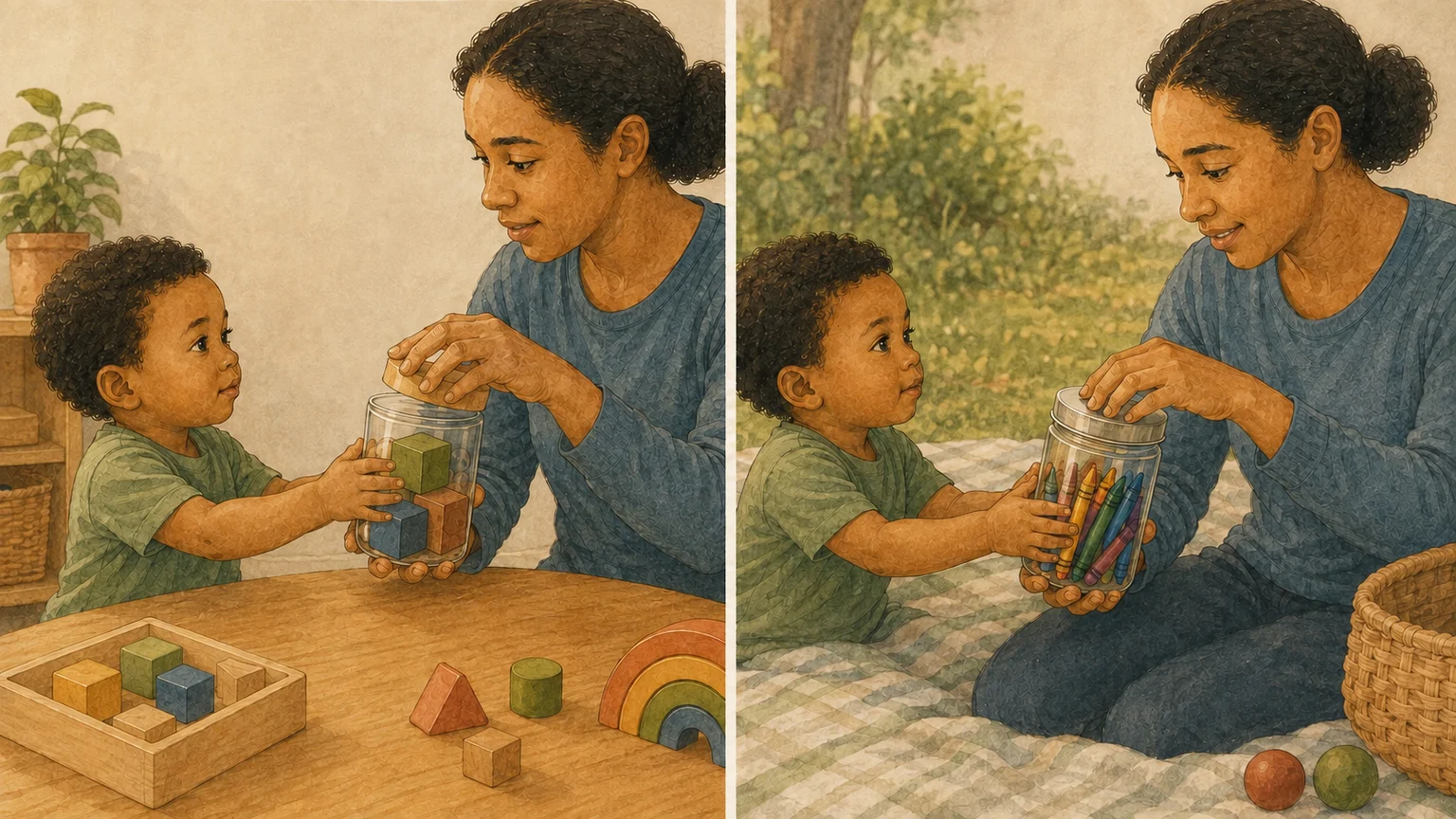
- Building with blocks
- Drawing during play
Why it is not a side to take
The two arrangements buy different things.
A table buys density. Many more clean opportunities per minute, all on the target you chose, than a kitchen moment can usually offer — and for a skill that needs a lot of repetition to establish, that density can meaningfully shorten how long it takes.
The day buys variation that supports transfer. The skill happens where it is needed, with the natural consequence, with many irrelevant details varying on their own. That does not guarantee generalization by itself — nothing does — but it takes on a good part of the work a deliberate generalization plan would otherwise have to do.
So the useful question is not which method, it is which one this target needs right now. Starting dense at a table and later moving into the day is a common pattern, not a rule every target has to follow — some skills are better taught the other way around, or in both places from the start.
The record is the part that breaks
A table session ends and someone writes down what happened. A morning in the kitchen ends and everyone goes on with the morning.
That is not a small problem: a naturalistic program without a record cannot tell whether it worked, and after a few weeks nobody can reconstruct what was actually taught. Something has to catch it in the moment — a counter, a tally, a phone.
Interlaza has two different answers for this. Its off-tablet trial mode (Record) lets an adult mark each response the same way an on-screen trial would be scored — accuracy, mastery, everything — so a skill taught at the sink and a skill taught on the screen sit in one history rather than two. Its free-operant modes (counting how often something happens, timing how long it lasts) are deliberately observational only: no accuracy, no mastery bar, because counting how often something happened and testing whether a child can do it are different questions, and merging them would produce a number that answers neither.
Practice questions
Written in the style of the RBT® and BCBA® exams. Pick an answer before you open the explanation.
-
Which description best fits natural environment teaching (NET)?
- Massed trials delivered at a table with the same materials each time
- Teaching embedded in the learner's ongoing activities, using the motivation of the moment and natural consequences
- Teaching that relies only on imitation of peers
- Unplanned play with no targets and no data
Show answer
Correct answer: B. Teaching embedded in the learner's ongoing activities, using the motivation of the moment and natural consequences
NET is still planned teaching with targets and data. What changes is where the opportunity comes from — the learner's current interest and activity — and that the consequence is the thing the learner was after.
-
At snack time the learner reaches for the juice. The technician holds it, waits for the learner to say "juice," then hands it over. What is the consequence for saying "juice"?
- An arbitrary reinforcer chosen by the technician
- A natural reinforcer directly related to the response
- A token exchanged later
- Extinction of reaching
Show answer
Correct answer: B. A natural reinforcer directly related to the response
The learner asked for juice and received juice. A consequence that follows directly from what the response specifies is a natural reinforcer — which is why requesting is the target that belongs most clearly in the day.
-
A technician places preferred toys in clear containers that the learner can see but cannot open. What is the technician doing?
- Arranging the environment to create opportunities to respond
- Placing the toys on extinction
- Applying response cost
- Fading a stimulus prompt
Show answer
Correct answer: A. Arranging the environment to create opportunities to respond
Waiting for opportunities is slow; arranging them is the skill. Visible-but-out-of-reach items create a moment in which the learner wants something and needs to ask for it.
-
Compared with teaching at a table, what is a commonly cited advantage of natural environment teaching?
- It always produces more learning trials per minute
- It needs no prompting
- Teaching across varied materials, settings and people can support generalization
- It does not require data collection
Show answer
Correct answer: C. Teaching across varied materials, settings and people can support generalization
Because the same target comes up with different objects, rooms and people, NET builds variety into teaching. It usually yields fewer opportunities per minute than a table session, which is why many programs combine the two.
More questions like these: RBT® practice exam · BCBA® practice questions
Further reading
- The mand — requesting, the target that most obviously belongs in the day.
- Discrete trial training — the other arrangement, and what density is for.