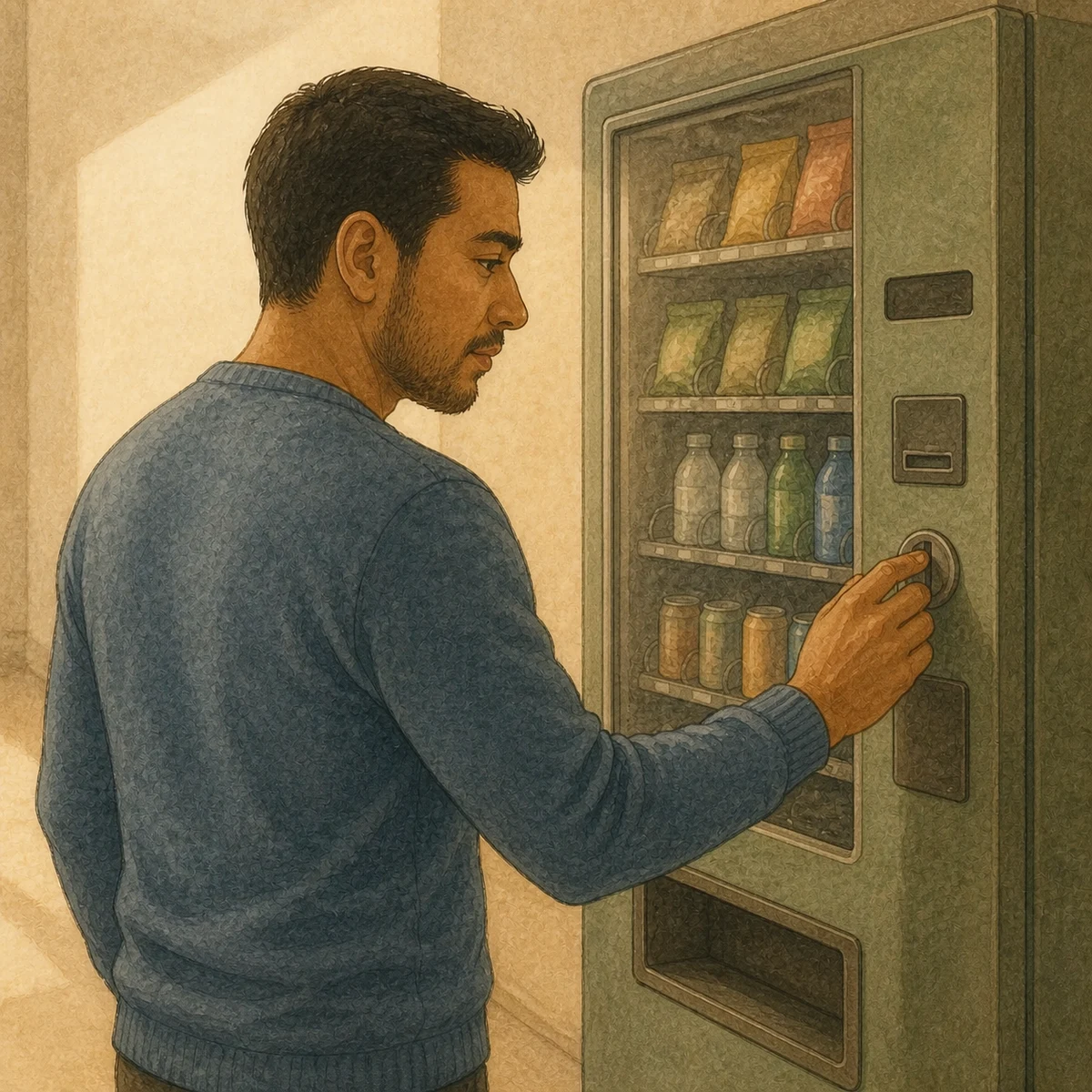
You put a coin in the machine and nothing comes out. You press the button again. You press the other buttons. You press harder, you shake it, you say something unkind to it — and a week later you walk past that machine without looking at it.
Nobody punished you. The behavior simply stopped producing the drink, and once that was reliably true it faded out. That is extinction, and everything that happened in between is the part worth understanding.
What it is, precisely
A behavior keeps happening because it produces something. Extinction is breaking that link: the behavior occurs and the thing it used to produce does not arrive.
Two things it is not:
It is not “ignoring”. Ignoring is one specific version, and it only works when the thing the behavior produced was attention. Escape extinction looks different: if screaming has been removing the task, extinction means the task keeps going despite the screaming — the adult is not ignoring anything, they are withholding the removal that used to happen. Simply staying calm about the scream while the task quietly gets set aside anyway is the opposite of that: the escape still happened, so nothing has been extinguished, however composed the adult looks doing it. Which of the two is happening depends on that history, not on whether the task is physically still on the table at any one moment.
It is not a punishment. Punishment adds something aversive, or takes away something the child already has, contingent on the behavior, to make it less likely. Extinction does neither — it does not add anything and it does not take away anything the child currently holds; it stops delivering a consequence the behavior used to produce. After extinction, the child is where they would be if the behavior had never worked, not worse off than that.
Which means the whole procedure depends on knowing what the behavior was producing. Get that wrong and you are running extinction on a consequence the behavior never had, while the real one keeps working.
The part everyone gets caught by
When a vending machine stops paying out, plenty of people press harder before they give up on it.
Children can do the same, and it is worth being ready for, though it does not happen every time — a review of published extinction procedures found the behavior getting worse before it improved in roughly a quarter of the cases studied. Where it does happen, the shape is usually the same: right after the link is broken, the behavior gets more frequent, more intense, or takes a new form for a while, before it fades.
Whether or not that burst shows up, giving in at any point teaches the same lesson: whatever amount of the behavior it took to get the old outcome back is now the price, and the next episode starts from there.
Which is why the question to settle before starting is not “will this work?” but “can everyone here hold it, every time, including grandma on Sunday?” If the answer is no, this is the wrong plan and a different one is better than a half-applied version of this one — and this is a plan to build with your child’s Instructor or a supervising BCBA, not to design alone from an article.
The behavior can also come back briefly after it has gone quiet — days or weeks later, without any new cause. It usually fades faster the second time. Knowing that in advance is what stops it being read as everything having failed.
Why it is never the whole plan
Extinction tells the child what no longer works. It tells them nothing about what does.
A child screaming for a break, with the screaming now producing nothing, still needs the break — and still has no way to ask for it. Leaving them there is both unkind and unstable: sooner or later some version of the behavior gets through, and what gets learned is that version.
So extinction runs beside teaching a request that produces the same outcome, easily and reliably. That is a procedure in its own right, and the two halves are what make each other work: the request becomes worth using because it is the only thing that works, and the old behavior fades because the request has taken its job.
Three times it is the wrong tool alone
Dangerous behavior. Letting a behavior run without its usual consequence, through a burst that makes it more intense, is not something to arrange at home from a written description. Safety comes first and the plan is built with someone who can supervise it.
When the adult does not control the consequence. If the behavior produces its own outcome directly — a sensation, a stimulation — nobody is delivering it, so there is no link an adult can withhold. What helps there is usually a different route to the same thing, not extinction; that is again a question for whoever is supervising, not something to design alone.
When it cannot be applied consistently. A behavior that only sometimes gets the old outcome tends to be harder to extinguish than one that used to get it every time — the same reason a slot machine holds people longer than a vending machine does. Half-applying this risks teaching the behavior to last longer, not shorter.
Further reading
- Shaping — the same differential logic used to build a behavior instead of retiring one.
- ABA data collection methods — how to tell a burst from a plan that is not working.